
Art Blog
This blog is for posting photos of new artwork and for the expression of sometimes random thoughts of oil painter Stephen St. Claire.
Understanding Abstract Art
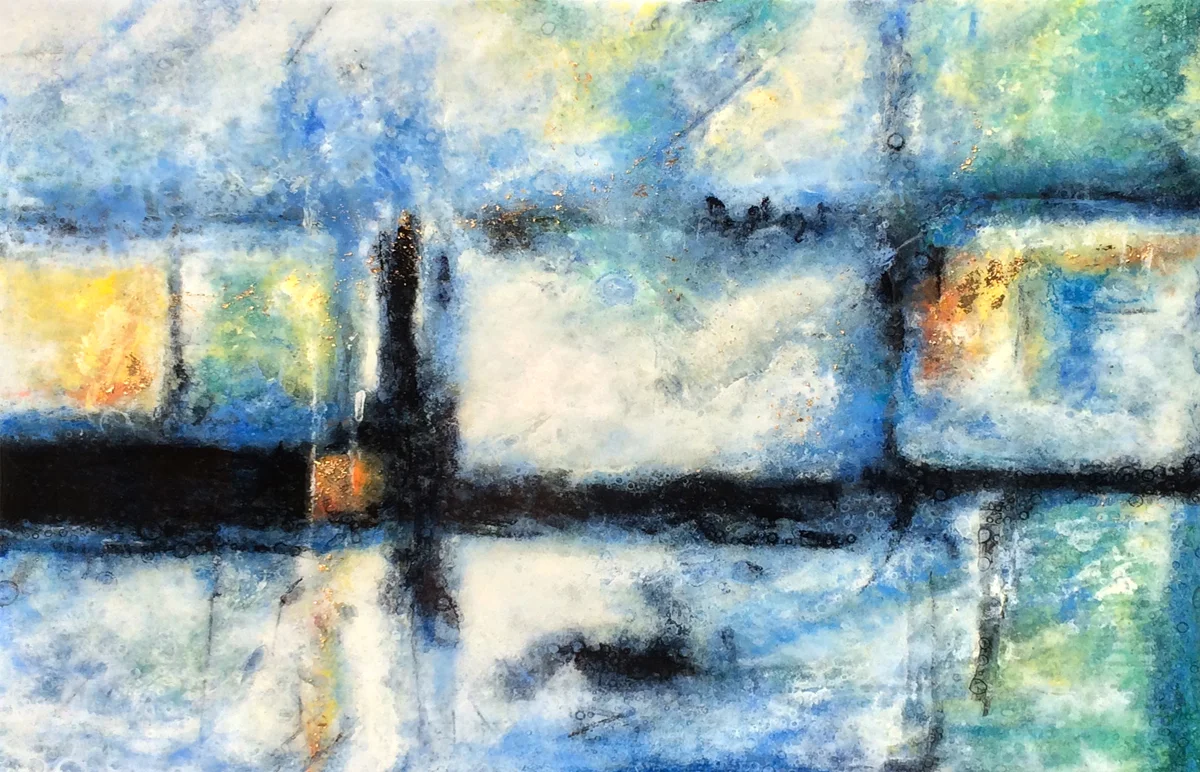
"Phi"
Are you one of the people who "get" abstract art or do you need a little help? Well, if you need help, don't feel bad. You are not alone. I have felt your pain. Landscape painting is easy enough to understand. A large rendition of a mountain landscape can be an awesome statement piece. But not all wall art is so easy to understand is it?
So if you need help with abstracts, I'd like to share a brilliant article from the Huffington Post written by Priscilla Frank entitled:
"Your Definitive Guide To Reading A Piece Of Abstract Art"
"Abstract art can be a doozy. We’d be lying if we said we’ve never approached a daunting canvas buzzing with indiscernible colors, shapes and stripes and, on the verge of a panic attack, grasped for the nearest museum guide. It’s hard to shake the nagging desire to solve the puzzle at hand, parse through the images and figure out what it all means. But, in our hearts, we know abstract art is no Sunday morning crossword puzzle, and should not be treated as such. On that note, we’re diving in.
"Abstract art is a beast all its own, and as such requires our utmost attention, patience and imagination. “Abstraction is staggeringly radical, circumvents language, and sidesteps naming or mere description,” Jerry Saltz writes in his wonderful manifesto on abstraction. “It disenchants, re-enchants, detoxifies, destabilizes, resists closure, slows perception, and increases our grasp of the world.” And so it may, but how do we actually engage with it?
"We’re taking it slow and attempting to navigate the perilous waters of abstract art one step at a time. Consider this a beginner’s guide to a lifelong relationship between, you, art, and your spirit guide Jerry Saltz. Here are nine things to consider next time you approach a seemingly impenetrable work of abstract art.
There’s no code to crack.
"As human beings, we take pleasure in solving problems. While this is useful in many aspects of life, the realm of abstract art is not one of them. Take a deep breath and let go of the desire to align every brushstroke to a symbolic meaning, every color to an aspect of the artist’s biography. While “getting” an artwork brings a momentary feeling of victory, bathing in its mystery brings enjoyment for far longer.
Don’t look at the clock.
"How long should you take to digest and fully experience a work of art? While the average time spent in front a museum artwork is around 30 seconds, truly taking in an artwork can take years. (Remember when Saltz said abstraction slowed perception?) Kitty Scott, director of visual arts at the Banff Centre, likened learning an artist’s visual language to learning a new written one. “Over the years, you may see 20 works, and then you start to understand their language and what their subject is,“ she explained.
Don’t talk about your five-year-old.
"You know, and have likely felt the urge to recite, the old “my five-year-old could do that.” And yes, sometimes it’s hard to reckon how a white canvas can sit in the MoMA and not in the “before” pile of an artist’s studio. One artist whose work is often looped into this category of the “childhish” is Cy Twombly, whose loopy scribbles often resemble youthful nonsense. But this passage by Roland Barthes may change your mind:
“It is not childish in form, for the child applies himself, presses down, rounds off, sticks out his tongue in his efforts, the child works hard to join the code of grown-ups. [Twombly] draw away from it, loosens, lags behind, his hand seems to levitate — as if the word had been written with his fingertips, not out of disgust or boredom but out of a kind of caprice open to the memory of a defunct culture which has left no more than the trace of a few words.”
"Now, could your child do that?
Don’t think of a picture, think of a thing.
"When we look at a picture, there are certain questions that immediately come to mind. The simplest being, What is it a picture of? When you shift gears a little, you’re free to open your mind up to the many questions that could make their way into your brain. What is this thing? What is it made of? What’s its speed? Its texture? Is it peaceful or cacophonous, heavy or light, open or closed? These questions, unlike the first, have no definitive answers, but may help you locate a starting point from which to navigate the artistic world before you.
"One easy place to start is color. As Wassily Kandinsky, one of the first abstract artists, wrote: “Color is a power which directly influences the soul. Color is the keyboard, the eyes are the hammers, the soul is the piano with many strings. The artist is the hand which plays, touching one key or another, to cause vibrations in the soul.” Perhaps start there. What colors do you see, hear and feel?
Ditch the questions completely.
"If asking questions feels too much like a cross examination, focus on affirmative statements instead. It may sound cliche to think about how the painting makes you feel, but the sentiment isn’t actually too far off. After all, abstract artist Agnes Martin did say “Abstract art is the concrete representation of our most subtle feelings.“
"In his book “Pictures and Tears“ James Elkins perused a guest book at the permanent display at the Rothko Chapel. From reading the visitor comments, one would expect the viewers had just witnessed a supernatural event or a religious epiphany rather than sat before an artwork. Comments ranged from “This makes me fall down,” to “The silence pierces deeply, to the heart. Once more I am moved — to tears.” Sometimes asking questions only proves to be a distraction.
That being said, don’t stress about getting emotional.
"We know few things are more frustrating than watching a fellow museum-goer weep uncontrollably in front of an artwork you think is just okay. You don’t have to love or even like every piece. Don’t be afraid to move on and find one that speaks to you.
Read the wall text.
"Here’s the part where you get a clue, if you’re so inclined. While the title will not, and should not, explain the piece, it could illuminate an aspect of it or an angle from which to view it you hadn’t noticed before. Let the work’s verbal and visual components bounce off each other, and harmonize. You may not get closer to understanding, you may even wind up more confused. It’s all part of the process. Also, you could wind up with an untitled piece.
"Along with the work’s title, knowing the era and geographical origin of the artwork will also help acclimate you to the atmosphere from which the piece emerged. To again quote Kandinsky, art and literature reflect “the dark picture of the present time and show the importance of what at first was only a little point of light noticed by few and for the great majority non-existent. Perhaps they even grow dark in their turn, but on the other hand they turn away from the soulless life of the present towards those substances and ideas which give free scope to the non-material strivings of the soul.”
"What would a work like this say about the world from which it came? The essence may be so radical it couldn’t yet be put into words.
Remember, some artists don’t even know, or care, what their work means.
"This is the part where you take a deep breath and fully accept the fact that you’re working outside the realm of answers and explanations. Even the artists themselves sometimes don’t dwell over why they’re making what they’re making. In a talk at MoMA, famed abstractionist Ellsworth Kelly was asked about his iconic “Chatham Series,” which dates back to 1972. “It’s hard to remember. I’m quite impressed with them now!“ He said, gesturing to the works and sighing. “But it’s always a mystery looking back.” If Ellsworth himself is content to marvel at the mystery of his own works, there’s no reason you shouldn’t be also.
Think about the fact that all art is really abstract art. And let your mind be blown.
"There’s an old art lovers’ tale about an American soldier telling Picasso his artworks aren’t close enough to life. He pulls out a photo of his fiancee and says: “This is what a picture should look like.“ Picasso, in typical Picasso fashion, responds: “Your girlfriend is rather small, isn’t she?” Point being, all art is abstracted from reality, or else museums would take up a lot more space.
"Whether this assuages your anxiety or throws you into a downward spiral of panic is up to you. To again quote Jerry’s infinite wisdom: “Abstraction is as old as we are. It has existed for millennia outside the West. It is present on cave walls, in Egyptian and Cypriot Greek art, Chinese scholar rocks, all Islamic and Jewish art — both of which forbid representation. Abstraction is only new in the West.” Abstraction was around way before your pretentious art school friend showed you his dot experiments and expected you to be impressed.
"This is where our brief foray into the wonders of abstraction comes to a close. While this short list may not help you understand your next trip to your local modern art museum, it may alleviate some of the pressure to understand it in the first place.
Chi
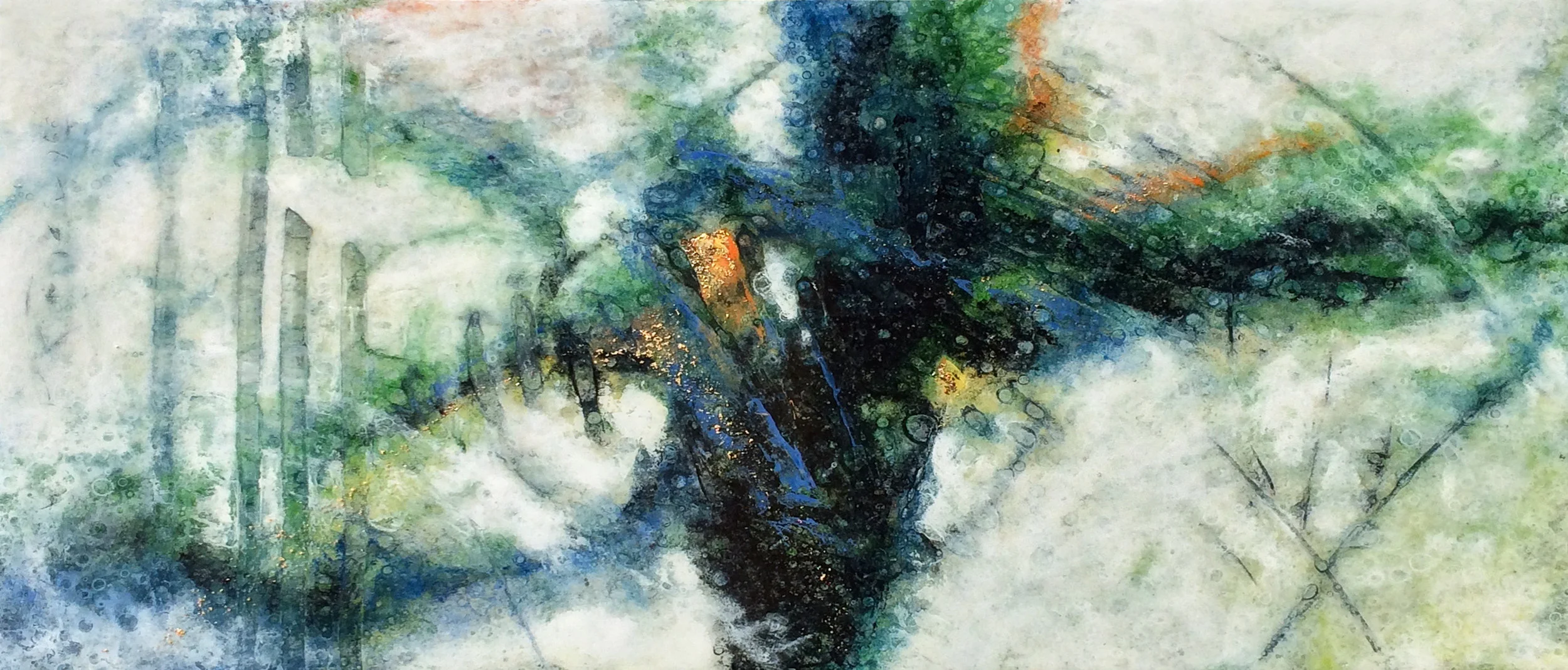
"Chi" (18" x 36")
Beginning an abstract art piece, is very different than beginning a landscape art piece in that I never, ever know what it will look like when complete. But I am learning that an abstract art painting will "tell me" when it's done. It's really great therapy -- divorcing ones mind from forced structure and let the structure of the painting form alongside the randomness of it. The place a landscape painting comes from is concrete most of the time: a picture either in my head or from a photo, usually of a western North Carolina or Asheville scene. But an abstract art piece comes from inside.
There is a short essay by Rainer Rilke I'd like to share. It's beautiful, and though written originally with the writing of prose or poetry, it applies so well to creating any art, and definitely applies to creating abstract art...
“Go into yourself. Find out the reason that commands you to write; see whether it has spread its roots into the very depths of your heart; confess to yourself whether you would have to die if you were forbidden to write.
This most of all: ask yourself in the most silent hour of your night: must I write? Dig into yourself for a deep answer. And if this answer rings out in assent, if you meet this solemn question with a strong, simple “I must,” then build your life in accordance with this necessity; your whole life, even into its humblest and most indifferent hour, must become a sign and witness to this impulse. Then come close to Nature. Then, as if no one had ever tried before, try to say what you see and feel and love and lose...
...Describe your sorrows and desires, the thoughts that pass through your mind and your belief in some kind of beauty - describe all these with heartfelt, silent, humble sincerity and, when you express yourself, use the Things around you, the images from your dreams, and the objects that you remember. If your everyday life seems poor, don’t blame it; blame yourself; admit to yourself that you are not enough of a poet to call forth its riches; because for the creator there is not poverty and no poor, indifferent place. And even if you found yourself in some prison, whose walls let in none of the world’s sounds – wouldn’t you still have your childhood, that jewel beyond all price, that treasure house of memories? Turn your attentions to it. Try to raise up the sunken feelings of this enormous past; your personality will grow stronger, your solitude will expand and become a place where you can live in the twilight, where the noise of other people passes by, far in the distance. - And if out of this turning-within, out of this immersion in your own world, poems come, then you will not think of asking anyone whether they are good or not. Nor will you try to interest magazines in these works: for you will see them as your dear natural possession, a piece of your life, a voice from it. A work of art is good if it has arisen out of necessity. That is the only way one can judge it.”
Process: Rocky Mountain Commission
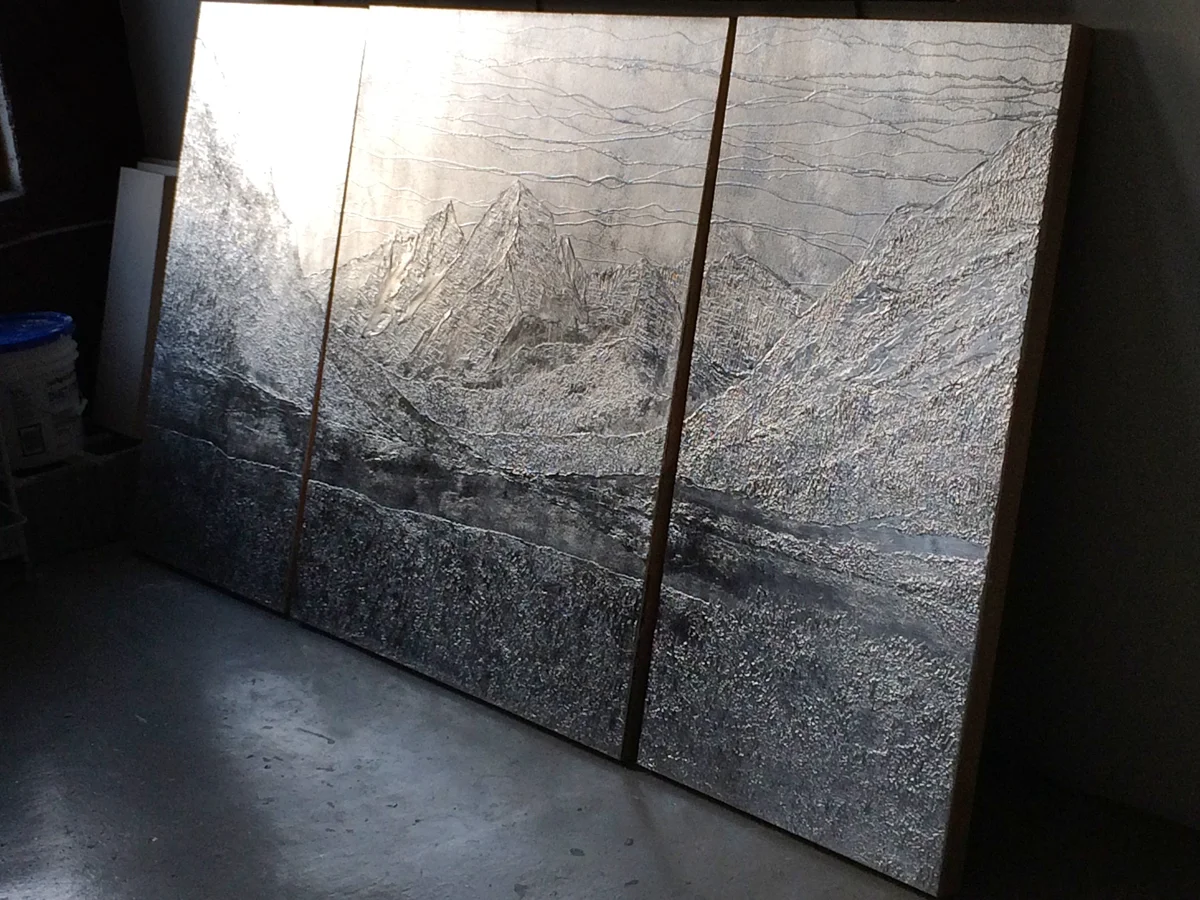
I love working large. Large artwork is commanding. Whether it’s intended as entrance art to grab you as soon as you enter a house or just a large wall piece, a sizable painting is artwork on a grand scale. I am currently working on a large commissioned art project for some nice folks in Austin, TX. The composition is triptych, and is based on a scene of the Rocky mountains -- mountains and birch trees reflecting in a lake. I just finished applying the metallic leaf to the textured surfaces of the panels yesterday and I was ready to go home -- turned off the lights and went to the back of the studio to get my keys, and when I turned around, I saw the panels reflecting back the late afternoon sunlight and I had to get a photo. Sorry. I get excited about stuff like this. One day, I'll have to just do a painting with no paint at all -- just metal covered with resin. I think that would be cool. Anyway, this one is ready for paint now, and by the end of the day, I'll have that first layer of paint applied.
Sometimes, when I get into a piece, it's cool to explore the background story. This scene from Glacier National Park required just a bit of research so that I'm not just painting a painting, but I'm depicting a place. I want to capture the "spirit" of that place. Throughout time, people have sought out Glacier National Park's rugged peaks, clear waters, and glacial-carved valleys; its landscape giving both desired resources and inspiration to those persistent enough to venture through it. Evidence of human use in this area dates back to over 10,000 years. By the time the first European explorers came into this region, several different tribes inhabited the area. The Blackfeet Indians controlled the vast prairies east of the mountains, while the Salish and Kootenai Indians lived in the western valleys, traveling over the mountains in search of game and to hunt the great herds of buffalo on the eastern plains.
The majority of early European explorers came to this area in search of beaver and other pelts. They were soon followed by miners and, eventually, settlers looking for land. By 1891, the completion of the Great Northern Railway sealed the area’s fate, allowing a greater number of people to enter into the heart of northwest Montana. Homesteaders settled in the valleys west of Marias Pass and soon small towns developed.
Around the turn of the century, people started to look at the land differently. For some, this place held more than minerals to mine or land to farm…they began to recognize that the area had a unique scenic beauty all to its own.
By the late 1800s, influential leaders like George Bird Grinnell, pushed for the creation of a national park. In 1910, Grinnell and others saw their efforts rewarded when President Taft signed the bill establishing Glacier as the country's 10th national park.
This painting has a way to go before completion, but I love the process: texture, aluminum leaf, paint and finish. More to come on this one...
"Summer Path Thru the Birch Trees"

Already Longing for Summer
Introducing...."Summer Path Thru the Birch Trees" (18" x 24") This was a revisiting of an older oil painting I did a couple years ago. This time, I went smaller and added more texture and trees. And rather than finished with a thick glossy coat of resin, I finished it with a softer, more subtle finish (satin varnish) which seals it all but still leaves all the texture visible. This composition reminds me of an awesome summer back when I was a young teenager. My brother had a best friend who had a family cabin and many, many acres of property on the north shore of Francois Lake in northern British Columbia, Canada. The deal was that he would spend a couple months there on the lake, and then we (my mom, dad and sister) would come visit for several days and pick him up. We meandered up the Pacific Coast Highway, visited my uncle on Bainbridge Island just off the coast from Seattle, crossed into Canada at Vancouver and drove north up the Fraser River Valley toward Francois Lake.
Francois Lake was a remote and awesome finger lake, very deep and very clear. The water was so pure that the locals had to ADD minerals to it so they could drink it and still get the minerals they needed to be healthy. Crazy. And the old farm (complete with rustic log house and cool old barns) was amazing. I'd never seen a place like it before. The old dirt roads and fields were mostly overgrown (it had been a while since it was a real working farm) but I clearly remember exploring along the road to the upper field, birch trees and wild flowers surrounding me everywhere. The sound of birch trees in the wind is unforgettable.
Anyway, I can't paint a landscape featuring birch trees and not remember that spectacular summer holiday. We've since visited Canada many times (from coast to coast) and never tire of the spectacular beauty of that place.
"Daybreak"
Light in the Darkness
"Daybreak in the Pines" (22" x 14") Here's the latest oil painting to roll off the line -- and you'll notice it's NOT a winter scene. I'm dreaming of summer landscapes already. This does not bode well for my sanity over the next couple months but dreaming of and painting scenes reminiscent of places here in North Carolina I hike with my wife Joy over the summer months -- that helps take the edge of 8 degree lows. :p
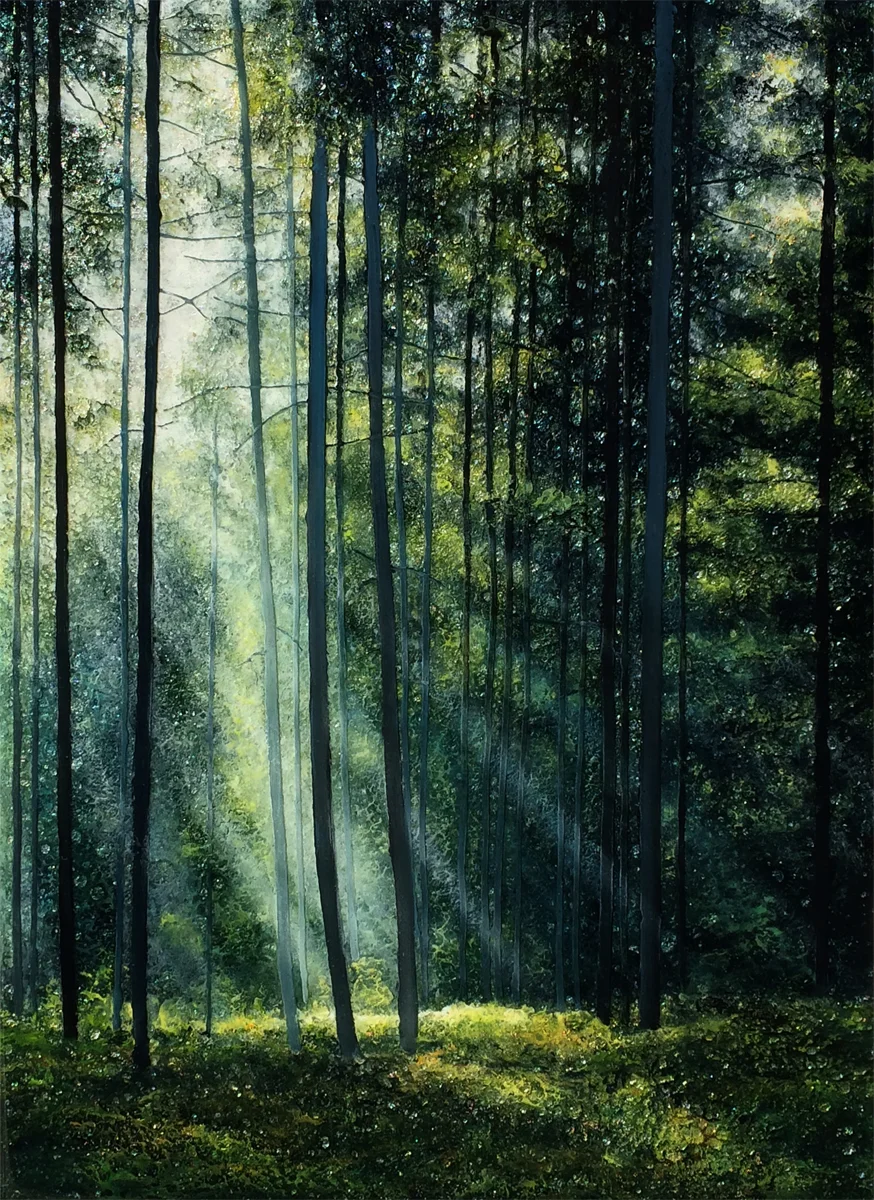
"Daybreak in the Pines" (22" x 14")
The West Wind
by William Cullen Bryant
Beneath the forest's skirts I rest,
Whose branching pines rise dark and high,
And hear the breezes of the West
Among the threaded foliage sigh.
Sweet Zephyr! why that sound of wo?
Is not thy home among the flowers?
Do not the bright June roses blow,
To meet thy kiss at morning hours?
And lo! thy glorious realm outspread--
Yon stretching valleys, green and gay,
And yon free hilltops, o'er whose head
The loose white clouds are borne away.
And there the full broad river runs,
And many a fount wells fresh and sweet,
To cool thee when the mid-day suns
Have made thee faint beneath their heat.
Thou wind of joy, and youth, and love;
Spirit of the new wakened year!
The sun in his blue realm above
Smooths a bright path when thou art here.
In lawns the murmuring bee is heard,
The wooing ring-dove in the shade;
On thy soft breath, the new-fledged bird
Takes wing, half happy, half afraid.
Ah! thou art like our wayward race;--
When not a shade of pain or ill
Dims the bright smile of Nature's face,
Thou lov'st to sigh and murmur still.
Revisiting a friend
Water and Light
"Morning on the Sound" (24" x 12"). When I create wall art, I sometimes start by experimenting with a brand new idea for the piece. Other times, I revisit an older idea I've already completed but look for ways to create a new oil painting that is both like and unlike the original (hey, Monet did that all the time). "Morning on the Sound" was such an effort. I did a painting similar to this composition awhile back and really enjoyed it -- but the scene depicted was of a coastline on a misty morning. This time, I wanted to go back to the same basic idea but...I've sent a strong east wind and blew the fog away.

"Morning on the Sound" (24" x 12")
The Trial Run
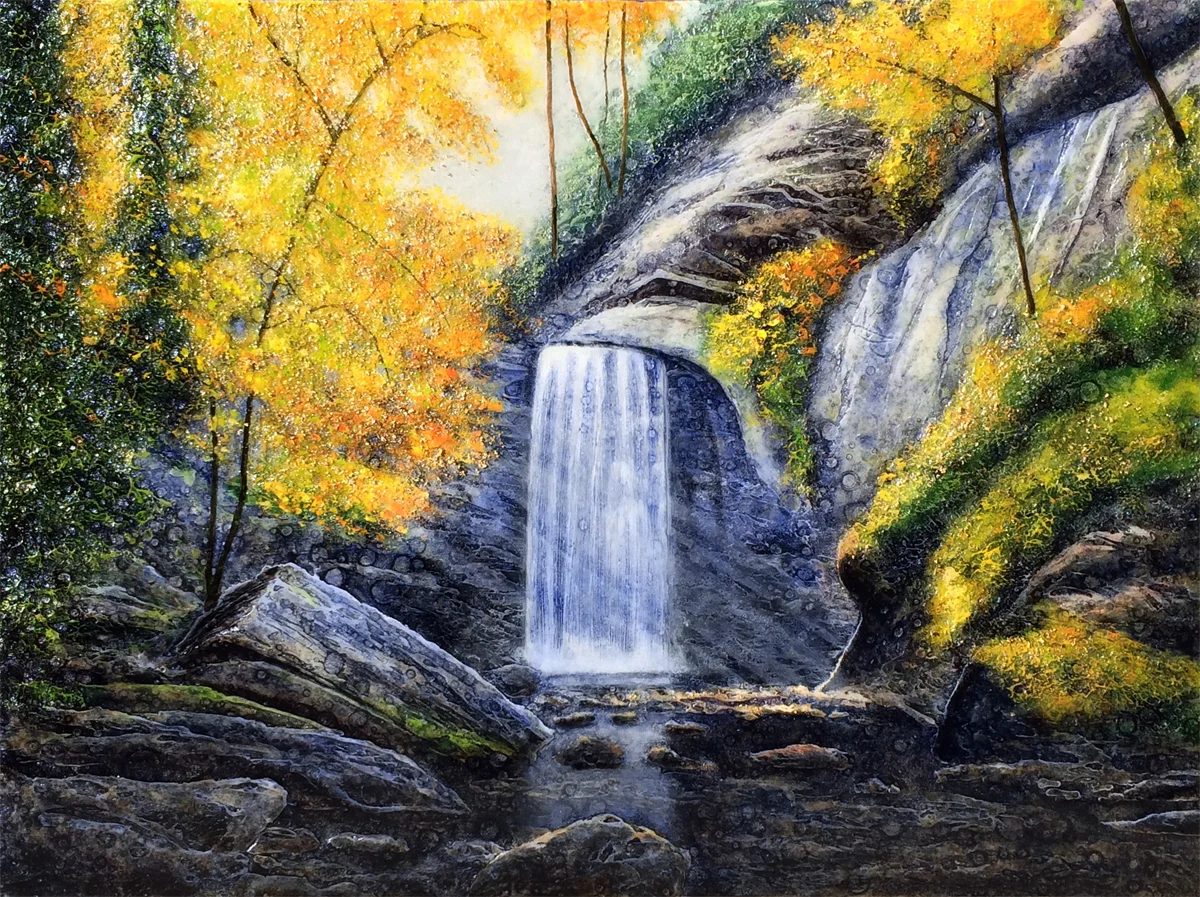
"Rainbow Falls" (18" x 24")
Waterfalls
I'm about ready now to apply aluminum leaf to my largest painting to date: Cullasaja Falls, and it occurred to me it would be a really good idea to practice on another waterfall so that I get this down. I don't want to "experiment" on this big one (it's just too large a statement piece to practice on and maybe mess up). So I chose one of my favorite waterfalls around here (about 45 minutes from my studio) and definitely one of the local landmarks. So I experimented on a much safer size (18" x 24") and I am REALLY happy with the way this one turned out and yep...I feel ready to tackle the big one now.
Asheville Channel Interview
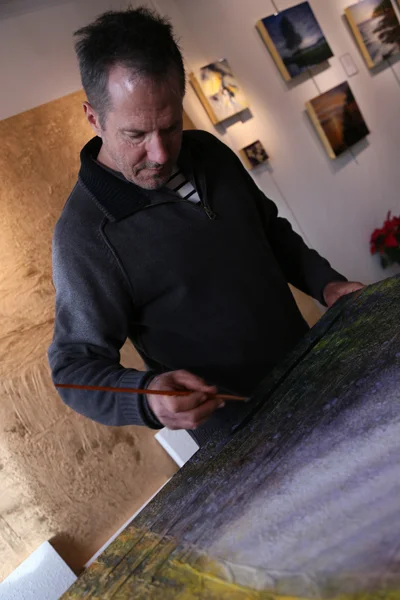
Asheville Channel Interview
Last week, and again yesterday, some really nice folks from the Asheville Channel came out to my studio for an interview (so I tried to sound like I was super interesting) and to take photos and video. So if you're interested in my work, or interested in practically anything to do with Asheville, check out the Asheville Channel: https://ashevillechannel.com/blog/st-claire-studio/. And...thanks Mario! You're team is awesome!
"Big Mamma" begins to sing....
Sealing of "Cullasaja Falls"
Attention Please
My son Gerin and I hauled my painting "Cullasaja Falls" (affectionately known as "Big Mamma") across the street to do the final sanding and sealing (seen here). Now, the composition is complete and it's ready for the application of aluminum leaf. This painting is begging to be a major statement piece or entrance art (eventually) and it's been exciting seeing it beginning to "come to life" and I can't wait to begin the color application. More to come...
An Experiment with Moonlight
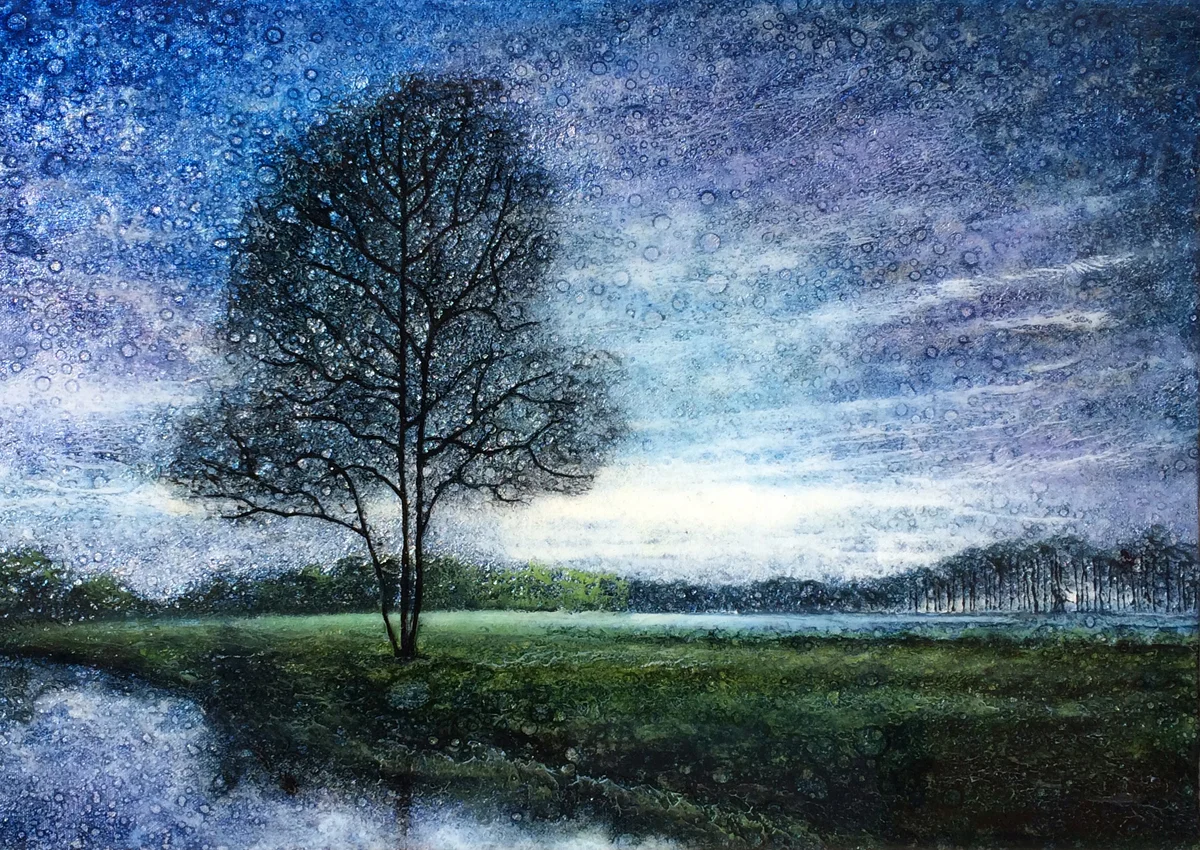
"Moonlight Sonata"
By the Light of the Silvery Moon
"Moonlight Sonata" was a bit of an experiment in that I don't usually paint a "moonlit" scene, mostly because I don't want the overall tone is too dark (simply because for my paintings to work, I need light being able to reflect off the aluminum leaf background and back through the paint I've applied. So for this painting to work, I had to play with the darkness of the color, the thickness of the paint, and the judicious placement of white paint (the most opaque paint I use). The result honestly is what I saw in my head, so I'm really happy with the piece. Three cheers for experimentation!
Blog Archive
-
2026
- Apr 29, 2026 Conversations Across Time: Caravaggio Apr 29, 2026
- Apr 26, 2026 Conversations Across Time: Raphael Apr 26, 2026
- Apr 21, 2026 Conversations Across Time: Michelangelo Apr 21, 2026
- Apr 16, 2026 Conversations Across Time: Sandro Botticelli Apr 16, 2026
- Apr 11, 2026 Conversations Across Time: Donatello Apr 11, 2026
- Apr 6, 2026 Conversations Across Time: Jan van Eyck Apr 6, 2026
- Apr 1, 2026 Conversations Across Time: Leonardo da Vinci Apr 1, 2026
- Mar 29, 2026 A Closing Reflection: Nine Ways Beauty Finds Us Mar 29, 2026
- Mar 27, 2026 Type Nine: The Recognition of Wholeness Mar 27, 2026
- Mar 24, 2026 Type Eight: The Encounter with Unfiltered Reality Mar 24, 2026
- Mar 18, 2026 Type Seven: The Pursuit of Radiant Possibility Mar 18, 2026
- Mar 16, 2026 Type Six: Beauty as Trust, Stability, and the Restoration of Ground Mar 16, 2026
- Mar 11, 2026 Type Five: Beauty as Insight and Essential Understanding Mar 11, 2026
- Mar 8, 2026 Type Four: Beauty as Identity and Emotional Truth Mar 8, 2026
- Mar 5, 2026 Type Three: Beauty as Significance and Radiance Mar 5, 2026
- Mar 1, 2026 Type Two: Beauty as Loving Connection Mar 1, 2026
- Feb 26, 2026 Type One: The Pursuit of Perfected Beauty Feb 26, 2026
- Feb 22, 2026 Why Personality Shapes the Way We Create and Experience Art Feb 22, 2026
- Feb 11, 2026 My Most Ambitious Project to Date: Pont Neuf at Dusk Feb 11, 2026
- Feb 8, 2026 The Human Rhythm: Why the Golden Section Matters Feb 8, 2026
- Jan 31, 2026 Nature’s Quiet Mathematics: The Golden Section at Work Jan 31, 2026
- Jan 24, 2026 The Golden Section in Architecture: Building with Human Scale Jan 24, 2026
- Jan 16, 2026 The Golden Section in Music: Proportions You Can Feel Jan 16, 2026
- Jan 14, 2026 The Golden Ratio in Art: Where Math Meets Beauty Jan 14, 2026
-
2025
- Dec 25, 2025 Finding Peace in the Christmas Chaos Dec 25, 2025
- Dec 14, 2025 Seeing Meaning: How Medieval Art Spoke Without Words Dec 14, 2025
- Nov 19, 2025 The Matterhorn and the Magic of Transformation Nov 19, 2025
- Nov 13, 2025 Commissions vs Completed Pieces…Which is Right for You? Nov 13, 2025
- Oct 28, 2025 What can I learn from Makoto Fujimura in 2025? Oct 28, 2025
- Oct 12, 2025 What can I learn from Pablo Picasso in 2025? Oct 12, 2025
- Oct 10, 2025 What can I learn from Raphael in 2025? Oct 10, 2025
- Oct 8, 2025 What can I learn from Georgia O’Keefe in 2025? Oct 8, 2025
- Sep 28, 2025 What can I learn from Caravaggio in 2025? Sep 28, 2025
- Jul 25, 2025 What can I learn from Thomas Gainsborough in 2025? Jul 25, 2025
- Jul 20, 2025 What can I learn from Leonardo da Vinci in 2025? Jul 20, 2025
- Jul 15, 2025 What can I learn from Michelangelo in 2025? Jul 15, 2025
- Jul 2, 2025 What can I learn from Van Gogh in 2025? Jul 2, 2025
- Jun 25, 2025 What can I learn from Renoir in 2025? Jun 25, 2025
- Jun 23, 2025 What can I learn from Claude Monet in 2025? Jun 23, 2025
- Jun 21, 2025 Using Complimentary Colors for Shading Jun 21, 2025
- Jun 17, 2025 How and When to use Complimentary Colors Jun 17, 2025
- May 30, 2025 Perspective in Art 101: How to Make Your Drawings Pop Off the Page May 30, 2025
- May 26, 2025 How to Really Understand Medieval Art May 26, 2025
- May 22, 2025 Staying Creative May 22, 2025
- May 10, 2025 AT Experience May 10, 2025
- May 3, 2025 Go Take a Walk! May 3, 2025
- Apr 25, 2025 Periods of Art: Mannerism Apr 25, 2025
- Apr 17, 2025 Finding Meaning in the Abstract: Pointers for Understanding Modern Art Apr 17, 2025
- Apr 16, 2025 The Quiet Labor Apr 16, 2025
- Apr 12, 2025 To Art: a Poem Apr 12, 2025
- Apr 5, 2025 The Enchantment of Art Nouveau Apr 5, 2025
- Mar 23, 2025 "What was it like going to art school?" Mar 23, 2025
- Mar 18, 2025 Why I Love the Rococo Period Mar 18, 2025
- Mar 4, 2025 Expressing Joy Through Art Mar 4, 2025
- Feb 28, 2025 The Connection Between Art and Frustration Feb 28, 2025
- Feb 23, 2025 Neoclassicism: Bringing Ancient Style Back to Life Feb 23, 2025
- Feb 18, 2025 On my walk Feb 18, 2025
- Feb 12, 2025 Art at the Very Beginning Feb 12, 2025
- Feb 10, 2025 Monet and Renoir: A Personal Reflection on Their Differences Feb 10, 2025
- Feb 6, 2025 The Fount of Creation: A poem Feb 6, 2025
- Feb 1, 2025 The Connection Between Art and Grief Feb 1, 2025
- Jan 29, 2025 A Journey Through Medieval Art: Stories from the Middle Ages Jan 29, 2025
- Jan 26, 2025 The Story of Art: The Romantic Period Jan 26, 2025
- Jan 16, 2025 The Relationship Between Music and Painting Jan 16, 2025
- Jan 12, 2025 Periods of Art: Baroque Jan 12, 2025
- Jan 11, 2025 Marketing your Artwork Jan 11, 2025
- Jan 7, 2025 Exploring the Golden Ratio in Art Jan 7, 2025
- Jan 3, 2025 Artistic Enlightenment: Lessons from Italy Jan 3, 2025
-
2024
- Dec 29, 2024 Why Travel is Crucial for Unleashing Creativity Dec 29, 2024
- Dec 22, 2024 Steps to Becoming a Full-Time Professional Artist Dec 22, 2024
- Dec 10, 2024 How to Determine Subject Matter for Your Next Painting Dec 10, 2024
- Dec 3, 2024 My Favorite Artist Dec 3, 2024
- Dec 1, 2024 Creativity and Exploration Dec 1, 2024
- Nov 13, 2024 Impressionistic Heroes of Mine Nov 13, 2024
- Nov 10, 2024 "So how do you DO this?" Nov 10, 2024
- Nov 3, 2024 Discovering the Bond Between Nature and Art Nov 3, 2024
- Nov 1, 2024 How Art Can Help Us Cope with Stress Nov 1, 2024
- Oct 27, 2024 How to Select the Perfect Art for Your Home Oct 27, 2024
- Oct 24, 2024 What to Do When You Feel Like Giving Up as an Artist Oct 24, 2024
- Oct 14, 2024 Book Review: The Artist’s Way Oct 14, 2024
- Oct 11, 2024 How to find Inspiration for your art Oct 11, 2024
- Sep 24, 2024 Crafting the Perfect Title for Your Artwork Sep 24, 2024
- Sep 14, 2024 The Worst Advice I’ve Ever Received as an Artist Sep 14, 2024
- Sep 8, 2024 Overcoming Artist’s Block: Practical Tips Sep 8, 2024
- Aug 30, 2024 Exploring Lessons from Vincent van Gogh Aug 30, 2024
- Aug 29, 2024 Why Purchase Original Artwork? Aug 29, 2024
- Aug 25, 2024 How do you determine the best size artwork to purchase? Aug 25, 2024
- Aug 15, 2024 "So, what's this painting worth?" Aug 15, 2024
- Aug 9, 2024 What color art would go best in my home? Aug 9, 2024
- Aug 4, 2024 How to deal with criticism as an artist Aug 4, 2024
- Mar 27, 2024 Question 12: "What do you do when you have a mental block?" Mar 27, 2024
- Mar 27, 2024 New Goals + Winter Months = "Outside the Box" Creativity Mar 27, 2024
- Jan 8, 2024 Question 11: Where do you get inspiration for your work? Jan 8, 2024
-
2023
- Sep 11, 2023 Question 10: "Do you have your work in galleries?" Sep 11, 2023
- Aug 27, 2023 Question 9: "How do you manage the business side of your art business?" Aug 27, 2023
- Aug 20, 2023 Question 8: "Do you advertise?" Aug 20, 2023
- Aug 13, 2023 Question 7: "How do you price your work?" Aug 13, 2023
- Jul 30, 2023 Question 6: "What are the positive points and negative points about having an 'open studio'?" Jul 30, 2023
- Jul 19, 2023 Question 5: "Would you mind critiquing my work at some point?" Jul 19, 2023
- Jul 1, 2023 Question 4: "Would you recommend art school, and if so, how would you find the right one?" Jul 1, 2023
- Jun 24, 2023 Question 3: "Did you go to art school? If so, where?" Jun 24, 2023
- Jun 16, 2023 Question 2: "How long have you been selling your work professionally?" Jun 16, 2023
- Jun 10, 2023 Question 1..."How long have you been an artist?" Jun 10, 2023
- Jun 4, 2023 So, you're thinking about art as a career? Jun 4, 2023
- Mar 3, 2023 "What inspires you as an artist?" Mar 3, 2023
- Feb 15, 2023 Should I buy a completed painting OR commission a painting? Feb 15, 2023
- Jan 23, 2023 "How do you Price Your Work?" Jan 23, 2023
-
2022
- Dec 1, 2022 An Artist in Italy (Part 3) Dec 1, 2022
- Nov 16, 2022 An Artist in Italy (Part 2) Nov 16, 2022
- Nov 8, 2022 An Artist in Italy (Part 1) Nov 8, 2022
- Oct 10, 2022 When Remodeling a Home... Oct 10, 2022
- Aug 22, 2022 How to Handle Failure Aug 22, 2022
- Jun 3, 2022 "What is it like being an artist these days?" Jun 3, 2022
- May 21, 2022 "Are All Artists Introverts?" May 21, 2022
- May 9, 2022 What Makes a Painting a Good Piece of Art? May 9, 2022
- Apr 1, 2022 The Story Behind…"Gentle Showers on a Summer Afternoon" Apr 1, 2022
- Mar 19, 2022 The Story Behind..."Blue Ridge Summer Afternoon" Mar 19, 2022
- Feb 18, 2022 Your Opinion Please... Feb 18, 2022
- Jan 22, 2022 What's in a Compliment? Jan 22, 2022
-
2021
- Dec 25, 2021 My Christmas Present to Joy Dec 25, 2021
- Dec 12, 2021 Deep in the Heart Dec 12, 2021
- Nov 29, 2021 "How do you know you're done with a painting?" Nov 29, 2021
- Nov 1, 2021 Does it Matter What Other People Think of My Art? Nov 1, 2021
- Oct 12, 2021 Creatively Inhaling... Oct 12, 2021
- Aug 31, 2021 More Fun than I Know What to do With Aug 31, 2021
- Aug 13, 2021 “Are You Self Taught?” Aug 13, 2021
- Jul 21, 2021 New Art Gallery on the West Coast Jul 21, 2021
- Jun 23, 2021 "Art from the Heart" vs "Commissioned Art" Jun 23, 2021
- May 28, 2021 More Questions and Answers May 28, 2021
- May 17, 2021 What does Diversity have to do with honest artwork? May 17, 2021
- May 4, 2021 More Questions and Answers May 4, 2021
- Apr 30, 2021 Questions and Answers Apr 30, 2021
- Apr 16, 2021 And the Next Blog Post is... Apr 16, 2021
- Mar 10, 2021 How do you create when you don't feel like creating? Mar 10, 2021
- Feb 11, 2021 "Mullaghmore": The Story Behind the Painting Feb 11, 2021
- Jan 28, 2021 A Look Back to "The Dark Year" Jan 28, 2021
- Jan 17, 2021 Studio Expansion...Hello Northeast! Jan 17, 2021
- Jan 7, 2021 How to Create the Perfect Painting Jan 7, 2021
-
2020
- Dec 1, 2020 A personal answer to a personal question... Dec 1, 2020
- Nov 4, 2020 Using Art to Express my Politics Nov 4, 2020
- Oct 16, 2020 Sometimes, just "having fun" is a good enough reason Oct 16, 2020
- Oct 4, 2020 The Best Painting Delivery Ever... Oct 4, 2020
- Sep 7, 2020 How a Dinky Little Virus Changed my Art Business Sep 7, 2020
- Aug 9, 2020 Adaptation: Survival of the Most Flexible Aug 9, 2020
- Aug 3, 2020 Story Behind the Painting: "Sundown over the Blue Ridge" Aug 3, 2020
- Jul 18, 2020 Cure for Covid blues Jul 18, 2020
- Jul 5, 2020 Where Does it Take You? Jul 5, 2020
- Jun 3, 2020 Story Behind the Painting: Autumn Day on the French Broad River Jun 3, 2020
- May 24, 2020 Story Behind the Painting: Saint-Jean-Cap-Ferrat May 24, 2020
- Apr 30, 2020 Q&A: SESSION TWO Apr 30, 2020
- Apr 22, 2020 Q&A: SESSION ONE Apr 22, 2020
- Apr 8, 2020 What I'll Miss When This Pandemic is Over... Apr 8, 2020
- Mar 20, 2020 Entertaining Angels Unawares Mar 20, 2020
- Mar 8, 2020 In Celebration of Art Mar 8, 2020
- Feb 27, 2020 "The Bridge" Feb 27, 2020
- Feb 8, 2020 The Most Interesting Question of the Year (but it's only February so...) Feb 8, 2020
- Jan 29, 2020 "Can I Watch You?" Jan 29, 2020
- Jan 14, 2020 From Point A to Point Z Jan 14, 2020
- Jan 5, 2020 An Impractical Idea Jan 5, 2020
-
2019
- Dec 17, 2019 My Beautiful Baby on Display Dec 17, 2019
- Dec 3, 2019 Regarding the Selection of an Artistic Theme Dec 3, 2019
- Nov 20, 2019 "What's Your Best Price on This Piece?" Nov 20, 2019
- Nov 13, 2019 A Really Unique Commission Project Nov 13, 2019
- Nov 6, 2019 Fun with Art Scammers Nov 6, 2019
- Nov 3, 2019 "How did you know you wanted to be an artist?" Nov 3, 2019
- Oct 30, 2019 How do you know when a painting is "done"? Oct 30, 2019
- Oct 20, 2019 The piece I had to paint: "Côte d’Azur" Oct 20, 2019
- Oct 18, 2019 Inspiration Everywhere! Oct 18, 2019
- Aug 26, 2019 Contentment vs Restlessness Aug 26, 2019
- Aug 14, 2019 "Why Should I Purchase Artwork?" Aug 14, 2019
- Aug 11, 2019 What Was Art School Like? Aug 11, 2019
- Aug 7, 2019 "The Four Seasons on the French Broad River" Aug 7, 2019
- Jul 30, 2019 Joy Unspeakable Jul 30, 2019
- Jul 7, 2019 Of Mountains and Oceans Jul 7, 2019
- Jul 3, 2019 Lessons I've Learned as an Artist Jul 3, 2019
- Jun 26, 2019 St.Claire Art Opening at the AC Hotel, Asheville Jun 26, 2019
- Jun 23, 2019 "How do you decide what to paint?" Jun 23, 2019
- Jun 5, 2019 One of my All-Time Heroes Jun 5, 2019
- Jun 2, 2019 Regarding "Inspiration" vs "Necessity" Jun 2, 2019
- May 29, 2019 The Best Complement I've Ever Received May 29, 2019
- May 19, 2019 "What are you Working on These Days?" May 19, 2019
- May 5, 2019 "Frankenstein-ing" a painting May 5, 2019
- Apr 17, 2019 The Big Reveal Apr 17, 2019
- Apr 3, 2019 "How do you Decide What to Paint?" Apr 3, 2019
- Mar 27, 2019 "I'm just not making the sales I need!" Mar 27, 2019
- Mar 20, 2019 Making the Most of Mistakes Mar 20, 2019
- Mar 10, 2019 Exploring Austin Galleries, Part 2 Mar 10, 2019
- Feb 25, 2019 Exploring Austin Galleries, Part 1 Feb 25, 2019
- Feb 10, 2019 Progress! Feb 10, 2019
- Jan 23, 2019 Preliminary Photos of my "Sails" Prototypes Jan 23, 2019
- Jan 16, 2019 The Benefits of Slowing Down Jan 16, 2019
- Jan 8, 2019 New Idea Taking Shape Jan 8, 2019
-
2018
- Dec 29, 2018 Looking Back and Looking Ahead Dec 29, 2018
- Dec 19, 2018 Percolating Creativity Dec 19, 2018
- Dec 16, 2018 So then... Dec 16, 2018
- Dec 12, 2018 What if... Dec 12, 2018
- Dec 5, 2018 Recent Projects on my Plate Dec 5, 2018
- Dec 3, 2018 Claude: My Creative Hero and Muse Dec 3, 2018
- Nov 22, 2018 Lessons I've Learned as an Artist Nov 22, 2018
- Nov 12, 2018 Planning for a Second Studio Location! Nov 12, 2018
- Nov 7, 2018 Steps Involved with a Painting Commission Nov 7, 2018
- Nov 4, 2018 How do you stay "balanced"? Nov 4, 2018
- Oct 28, 2018 What makes art "Art"? Oct 28, 2018
- Oct 21, 2018 "How Did You Stumble Across This Type of Artwork?" Oct 21, 2018
- Oct 17, 2018 "A Personal History" Oct 17, 2018
- Oct 14, 2018 Commission Confusion Oct 14, 2018
- Oct 10, 2018 "Aqueous Dream" Oct 10, 2018
- Oct 7, 2018 Beauty in the Center of the Pit Oct 7, 2018
- Sep 30, 2018 Only North Carolina? Sep 30, 2018
- Sep 23, 2018 The Price of Being a Landscape Painter Sep 23, 2018
- Sep 9, 2018 Thoughts on New Directions, New Possibilities Sep 9, 2018
- Aug 29, 2018 SURVEY: GLOSSY OR SATIN Aug 29, 2018
- Aug 22, 2018 Regarding Commissioning a Painting Aug 22, 2018
- Aug 19, 2018 On the Brink of a Huge Failure Aug 19, 2018
- Aug 7, 2018 "The Trail That Never Ends" Aug 7, 2018
- Aug 5, 2018 Inspration Begets Inspiration Aug 5, 2018
- Jul 19, 2018 Rejuvenating Creativity! Jul 19, 2018
- Jul 15, 2018 A Word About Accolades Jul 15, 2018
- Jul 10, 2018 Where it Began Jul 10, 2018
- Jul 4, 2018 Funny Things People Say in an Art Studio Jul 4, 2018
- Jun 29, 2018 "The Time Between Times" Jun 29, 2018
- Jun 27, 2018 World View #8: Post Modernism Jun 27, 2018
- Jun 21, 2018 World View #7: New Age Pantheism Jun 21, 2018
- Jun 12, 2018 A New Opportunity -- A New Idea Jun 12, 2018
- Jun 6, 2018 The Art of Dinner (at the Grove Park Inn) Jun 6, 2018
- Jun 3, 2018 National Geographic?!? Jun 3, 2018
- Jun 1, 2018 World View #6: Modernism Jun 1, 2018
- May 24, 2018 The Art of Dinner (with the Dallas Cowboys) May 24, 2018
- May 13, 2018 Carving Mountains from Scratch May 13, 2018
- May 10, 2018 "Trigger Warning" May 10, 2018
- May 7, 2018 World View #5: Existentialism May 7, 2018
- Apr 29, 2018 World View #4: Nihilism Apr 29, 2018
- Apr 11, 2018 World View #3: Naturalism Apr 11, 2018
- Apr 4, 2018 World View #2: Deism Apr 4, 2018
- Mar 26, 2018 World View #1: Theism Mar 26, 2018
- Mar 23, 2018 A Time to be Disturbed Mar 23, 2018
- Mar 14, 2018 Understanding Art 101 Mar 14, 2018
- Mar 8, 2018 The Organ Mountains Mar 8, 2018
- Mar 7, 2018 "Remember...there are no mistakes with art" Mar 7, 2018
- Mar 2, 2018 The Biltmore Estate Mar 2, 2018
- Feb 21, 2018 How to Make a Living as an Artist (Part 2) Feb 21, 2018
- Feb 12, 2018 How to Make a Living as an Artist Feb 12, 2018
- Feb 4, 2018 How do you create when you don't feel creative? Feb 4, 2018
- Jan 24, 2018 Gallery Representation in Hendersonville! Jan 24, 2018
- Jan 19, 2018 Metalizing the Biltmore Estate Jan 19, 2018
- Jan 15, 2018 Four Seasons on the Blue Ridge Jan 15, 2018
- Jan 11, 2018 About Ice... Jan 11, 2018
- Jan 10, 2018 What's Next? Jan 10, 2018
-
2017
- Dec 20, 2017 Mountain Top Experiences Dec 20, 2017
- Dec 18, 2017 The Power of Mystery Dec 18, 2017
- Dec 7, 2017 Forsyth Park Fountain Dec 7, 2017
- Dec 6, 2017 Angsty or Terrified? Dec 6, 2017
- Dec 4, 2017 To the "Angsty" Artist... Dec 4, 2017
- Dec 3, 2017 "I woudn't pay HALF of what he's asking!" Dec 3, 2017
- Nov 20, 2017 "On the Water" Nov 20, 2017
- Nov 19, 2017 Song of Autumn Nov 19, 2017
- Nov 15, 2017 "Top of the Mountain" Nov 15, 2017
- Nov 5, 2017 "How do you decide what to paint?" Nov 5, 2017
- Nov 2, 2017 "Valley of Shadows" Nov 2, 2017
- Nov 1, 2017 Forest of Autumn Gold Nov 1, 2017
- Oct 25, 2017 Then and Now Oct 25, 2017
- Oct 24, 2017 Catawba Falls Oct 24, 2017
- Oct 18, 2017 "Valley of Shadows" Oct 18, 2017
- Oct 11, 2017 Autumn River Song Oct 11, 2017
- Oct 3, 2017 Autumnal Shift Oct 3, 2017
- Sep 28, 2017 Mystic Summer Morning Sep 28, 2017
- Sep 24, 2017 Valley of Shadows Sep 24, 2017
- Sep 1, 2017 the breakers Sep 1, 2017
- Aug 24, 2017 When the Sun Went Dark Aug 24, 2017
- Aug 17, 2017 Secret Blog Post Aug 17, 2017
- Aug 14, 2017 Waterfalls Everywhere! Aug 14, 2017
- Aug 11, 2017 "Cullasaja Falls" Completion photo Aug 11, 2017
- Aug 8, 2017 Finishing up "My Marathon" Aug 8, 2017
- Aug 1, 2017 One of the Best Days Ever! Aug 1, 2017
- Jul 26, 2017 "Glacial Fractures in situ" Jul 26, 2017
- Jul 24, 2017 Inspiration and Rest Jul 24, 2017
- Jul 18, 2017 Half Baked Ideas... Jul 18, 2017
- Jul 13, 2017 Oaks on the Water Jul 13, 2017
- Jul 9, 2017 Challenged to the Core Jul 9, 2017
- Jul 5, 2017 Boats on the Water Jul 5, 2017
- Jun 30, 2017 Glacial Fractures Jun 30, 2017
- Jun 29, 2017 Winter in the Summer! Jun 29, 2017
- Jun 27, 2017 What's in a Compliment? Jun 27, 2017
- Jun 23, 2017 Thoughts on a Mighty Failure Jun 23, 2017
- Jun 20, 2017 Sunrise on the Mountain Jun 20, 2017
- Jun 14, 2017 The Last Sunset (is that dramatic or what?) Jun 14, 2017
- Jun 12, 2017 Sunset or Sunrise? End or Beginning? Jun 12, 2017
- Jun 9, 2017 At the End of the Day Jun 9, 2017
- Jun 8, 2017 Giverny: My Homage to the Man Jun 8, 2017
- Jun 2, 2017 A Funny Thing Happened at the Studio Today... Jun 2, 2017
- Jun 2, 2017 Sunrise, Sunset... Jun 2, 2017
- May 29, 2017 Color Explosion May 29, 2017
- May 22, 2017 My Largest Painting to Date... May 22, 2017
- May 18, 2017 What to do with 2000 visitors in an art studio... May 18, 2017
- May 9, 2017 My Creative Muse May 9, 2017
- May 3, 2017 Joys of Life May 3, 2017
- Apr 28, 2017 Regarding Art & Beauty Apr 28, 2017
- Apr 25, 2017 Getting Better Acquainted Apr 25, 2017
- Apr 23, 2017 Rainy Sunday Morning Thoughts Apr 23, 2017
- Apr 22, 2017 Personal Thoughts Apr 22, 2017
- Apr 19, 2017 Favorite Hikes (Inspiration in the Making)... Apr 19, 2017
- Apr 15, 2017 Inspiration is Everywhere (some of our favorite hiking trails) Apr 15, 2017
- Apr 9, 2017 "Where should we eat tonight?" Apr 9, 2017
- Apr 6, 2017 Who Else Should We See in the District? Apr 6, 2017
- Apr 1, 2017 Spring in Western North Carolina Apr 1, 2017
- Mar 29, 2017 "Can you really make a living here?" Mar 29, 2017
- Mar 25, 2017 Of Ruination and Rescue Mar 25, 2017
- Mar 21, 2017 How I decide what to paint... Mar 21, 2017
- Mar 18, 2017 Musings of an artist... Mar 18, 2017
- Mar 14, 2017 Winter thoughts Mar 14, 2017
- Mar 13, 2017 "What makes this painting so sparkly?" Mar 13, 2017
- Mar 10, 2017 You're From Where? Mar 10, 2017
- Mar 5, 2017 "No Boundaries" Mar 5, 2017
- Mar 3, 2017 Appalachian Trail Mar 3, 2017
- Mar 2, 2017 What is 'good' art? Mar 2, 2017
- Feb 26, 2017 A Trip to the Art Museum Feb 26, 2017
- Feb 23, 2017 "The Rules" of Art Feb 23, 2017
- Feb 15, 2017 To School or Not to School... Feb 15, 2017
- Feb 10, 2017 How Do I Start This Thing? Feb 10, 2017
- Feb 9, 2017 Rocky Mountains reflection Feb 9, 2017
- Feb 7, 2017 Getting Inspired Feb 7, 2017
- Feb 5, 2017 Inspiration for a painting... Feb 5, 2017
- Jan 31, 2017 Understanding Abstract Art Jan 31, 2017
- Jan 29, 2017 Chi Jan 29, 2017
- Jan 26, 2017 Process: Rocky Mountain Commission Jan 26, 2017
- Jan 12, 2017 "Summer Path Thru the Birch Trees" Jan 12, 2017
- Jan 9, 2017 "Daybreak" Jan 9, 2017
-
2016
- Dec 31, 2016 Revisiting a friend Dec 31, 2016
- Dec 28, 2016 The Trial Run Dec 28, 2016
- Dec 17, 2016 Asheville Channel Interview Dec 17, 2016
- Nov 28, 2016 "Big Mamma" begins to sing.... Nov 28, 2016
- Nov 22, 2016 An Experiment with Moonlight Nov 22, 2016
- Nov 17, 2016 Transfiguration Nov 17, 2016
- Nov 11, 2016 My Cluttered World Nov 11, 2016
- Oct 30, 2016 Sacred Space Oct 30, 2016
- Oct 22, 2016 Omikron (Fire & Ice) Oct 22, 2016
- Oct 19, 2016 "Do you know what you're going to paint?" Oct 19, 2016
- Oct 15, 2016 "Golden Pathway" Oct 15, 2016
- Oct 14, 2016 Flowers, Flowers Everywhere Oct 14, 2016
- Oct 13, 2016 OKC 2 ("The Bridge") Oct 13, 2016
- Oct 12, 2016 Headed west... Oct 12, 2016
- Sep 7, 2016 A Year of "Largest" Sep 7, 2016
- Aug 2, 2016 Transformation of an idea... Aug 2, 2016
- Jul 27, 2016 Beginning my "marathon" painting: Cullasaja Falls Jul 27, 2016
- Jul 18, 2016 My Marathon Jul 18, 2016
- Jul 13, 2016 Welcome! Jul 13, 2016
- Jul 11, 2016 Aegean Waters Jul 11, 2016
- Jul 2, 2016 The Red Planet Jul 2, 2016
- Jun 17, 2016 Puzzling and Playing Jun 17, 2016
- Jun 10, 2016 St.Claire Art Studio Tour Jun 10, 2016
- Jun 6, 2016 Hominy Valley Jun 6, 2016
- May 25, 2016 "The Acolytes" is installed in Georgetown, SC May 25, 2016
- May 19, 2016 "Zuma" May 19, 2016
- May 18, 2016 Fishy Art May 18, 2016
- May 13, 2016 "The Journey" May 13, 2016
- May 10, 2016 Hyatt Ridge (26" x 16") May 10, 2016
- May 5, 2016 "Broad River in October" May 5, 2016
- May 2, 2016 A Blast From the Past May 2, 2016
- Apr 22, 2016 Beginnings II Apr 22, 2016
- Apr 21, 2016 Appalachian Panorama Apr 21, 2016
- Apr 18, 2016 "How do you get the aluminum on the painting?" Apr 18, 2016
- Apr 14, 2016 Beginnings Apr 14, 2016
- Mar 24, 2016 St. Claire Art News & Updates Mar 24, 2016
- abstract
- aluminum leaf
- Appalachian Trail
- art as a career
- art business
- art career
- art career advice
- art commission
- art composition
- art creation
- art critique
- art education
- Art Gallery
- art gallery
- art history
- art inspiration
- art marketing
- art movements
- art periods
- art poetry
- art process
- art purchase
- art sales
- art school
- Art Studio
- art studio
- art studios
- Art Studios
- art technique
- artist
- Artist advice
- artist advice
- artist representation
- artisti creation
- artistic expression
- artistic inspiration
- artwork
- Artwork
- Asheville
- asheville
- Asheville art gallery
- Asheville art studio
- Asheville artist
- Asheville artists
- Autumn
- autumn
- birch
- blue
- Blue Ridge
- commission
- Commission
- complimentary colors
- contemporary art
- creative inspiration
- Creativity
- creativity
- cullasaja falls
- fine art
- golden section
- grief
- grove park inn
- Hiking
- impressionism
- inspiration
- installation art
- landscapes
- medieval art
- mountain trails
- mountains
- North Carolina
- ocean
- ocean artwork
- oil painting
- Oil paintings
- origins
- process
- Professional artist
- red
- reflection
- Renoir
- Resin art
- River
- River Arts District
- Statement peice
- studio
- summer
- sunset
- Sunset
- travel
- travel and creativity
- trees
- understanding art
- unique wall art
- water
- waterfall
- wave
- western north carolina
- Western North Carolina
- woods
- World Views