
Conversations Across Time: Jan van Eyck
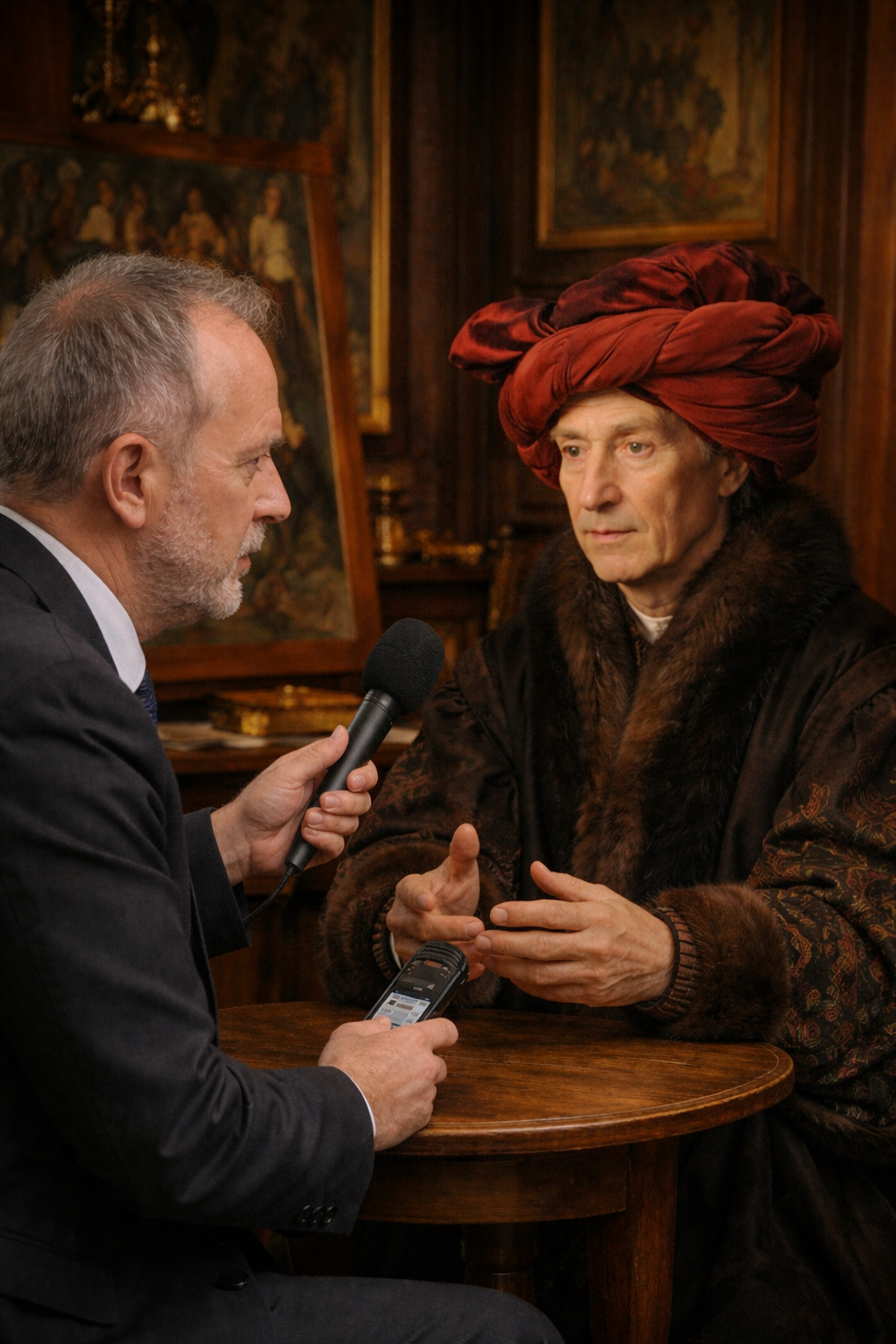
An ongoing series at stclaireart.com in which we imagine sitting down with the greatest artists in history.
Me: Master van Eyck, you are considered the father of oil painting — a technique so revolutionary it changed everything that came after you. Did you know at the time what you were doing?
Jan: I knew that I could see things I could not yet paint. That is where it begins, always — the frustration between the eye and the hand. Tempera was honest but limited. It dried before you could think. Oil gave me time. It gave me depth. You could build it in layers, like glass laid over glass, and the light would travel down through all of it and come back changed.
Me: Like looking into something rather than at it.
Jan: Precisely. A tempera painting sits on the surface. Oil painting pulls you in. I wanted the fur on a collar to feel cold. I wanted a jewel to hold actual light inside it. Whether anyone called it revolutionary was not my concern. I had problems to solve.
Me: Your paintings are filled with almost impossibly small details — inscriptions on rings, reflections in convex mirrors, individual hairs. Was that devotion, or something closer to obsession?
(A quiet pause. He seems to consider the difference carefully.)
Jan: I am not sure those are different things. When I painted the Ghent Altarpiece, there are figures in the distance — pilgrims, barely the size of a thumb — and I painted the creases in their robes. No one was meant to see that. No one could see that, with the naked eye.
Me: Then why do it?
Jan: Because God could see it. I was not making paintings for rooms. I was making them as a form of — I suppose you might call it testimony. That this world, this specific world, with its textures and its light and its particular beauty, existed and was worth recording exactly as it was. Every thread in every carpet. Every vein in every hand.
Me: What do critics and historians get most wrong about you?
Jan: They call me a craftsman first and an artist second. As if the technical mastery somehow diminishes the feeling behind it. But consider — to paint a human eye so that it appears genuinely wet, genuinely alive, genuinely thinking — that is not craft. That is an act of profound attention to what it means to be human. The technique is simply the vocabulary. What I was saying with it is another matter entirely.
Me: And what were you saying?
Jan: That the visible world is sacred. Every object, every face, every fall of light through a window. I did not need to paint heaven to paint something holy.
Me: You painted the Arnolfini Portrait — one of the most analyzed paintings in history. That mirror in the background showing two figures — one of them possibly you. Was that deliberate? A kind of signature?
(The faintest smile.)
Jan: I signed the painting on the wall above that mirror. Johannes de Eyck fuit hic. Jan van Eyck was here. Most painters signed their work on the frame, which could be separated, lost. I signed it into the world of the painting itself. As a witness. As someone who was present.
Me: And the mirror — the two figures reflected in it?
Jan: A mirror shows what the painting cannot show directly. It is the room turning to look back at itself. I find it strange that people find it strange.
Me: If you had one day in the present — our world, right now — what would you do first?
(He thinks for a moment, genuinely.)
Jan: I would want to see my paintings under modern light. The lighting in the fifteenth century was — not ideal. Candles and small windows. I painted things I could never see properly once they were finished and hung.
Me: That's a heartbreaking thought.
Jan: (Simply.) It is what it is. I would also want to see a microscope. I have heard there are instruments now that can see into matter itself — into the structure of pigment and oil. I would want to know if what I built holds together the way I intended. Whether the layers are still there.
Me: They are. Your paintings are among the best preserved in existence.
(A long pause. Something crosses his face that is difficult to name.)
Jan: Good. That is — yes. Good.
Me: One last question. What would you say that art is actually for?
Jan: To bear witness. We are here for such a short time, and the world is so extraordinarily specific — this face, this light, this moment. Art says: this was real. This existed. Someone saw it and thought it worth preserving. Without that, everything simply disappears. Kings, merchants, the girl by the window, the dog at the foot of the bed — all of it gone as if it never was. I could not accept that. I still cannot.
Jan van Eyck (c. 1390–1441) was a Flemish painter working in Bruges, widely credited with perfecting and popularizing oil painting as a medium. His meticulous attention to surface, light, and texture fundamentally transformed Western art. His best known works include The Arnolfini Portrait and the Ghent Altarpiece, the latter considered one of the most important paintings ever made.
This is an imagined interview. Van Eyck left almost no personal writings, and his responses here are constructed from historical research, close study of his work, and what the paintings themselves suggest about the man who made them. No direct quotes are presented as real.
No deceased artists were harmed in the making of this series.