
Conversations Across Time: Leonardo da Vinci
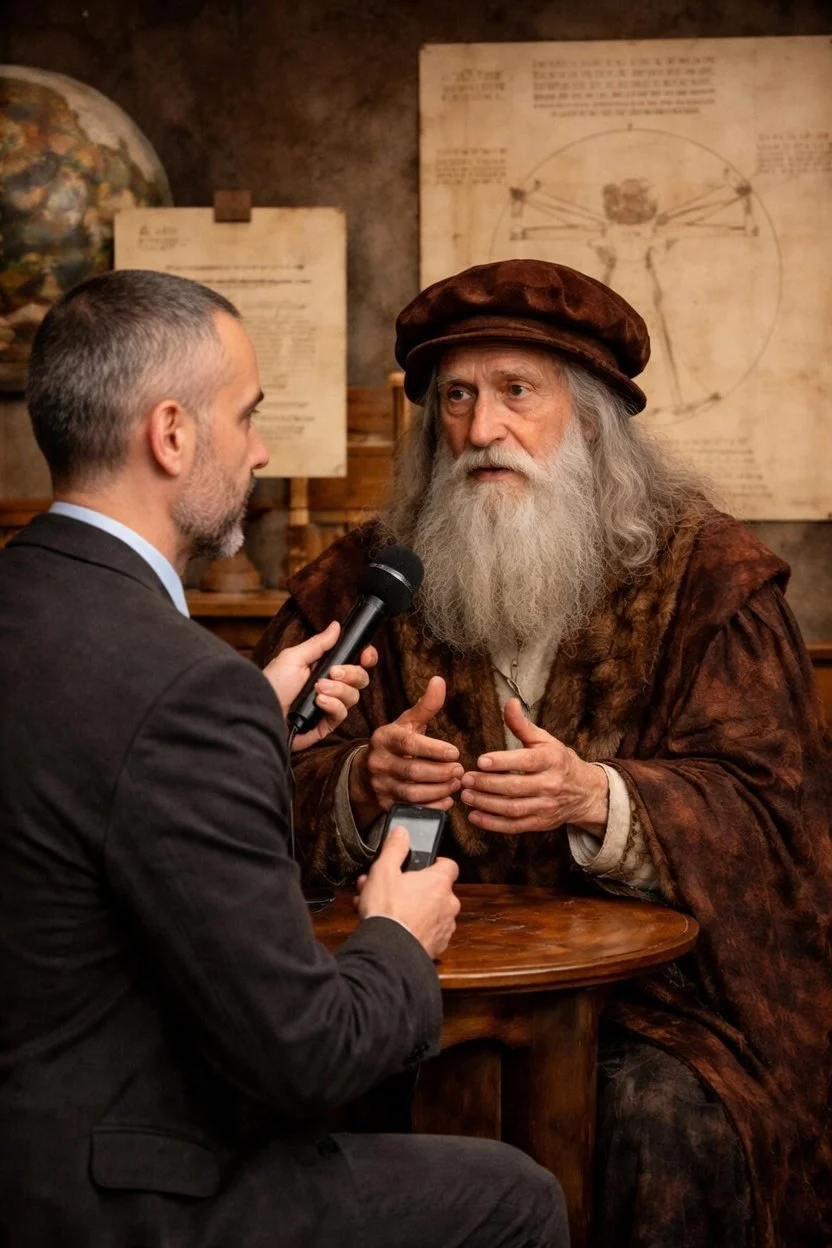
An ongoing series at stclaireart.com in which we imagine sitting down with the greatest artists in history.
Me: You are perhaps the most famous artist who ever lived. Does that word — "artist" — even feel adequate to describe what you do?
Leonardo: It makes me smile, and not entirely with pleasure. A painter, they call me. As if the eye and the hand are the whole of it. But the eye must be educated by the mind, and the mind must be fed by everything — the way water moves around a stone, the way light enters an eye, the way a muscle pulls against a bone.
Me: So the painting is almost the last step.
Leonardo: Exactly so. I have never understood why a man would choose to know only one thing. The world is not divided into categories. Why should I be?
Me: Your notebooks are filled with inventions, anatomy, mathematics, music. Did you ever feel pulled in too many directions? Did it torment you?
Leonardo: (A long pause. He turns a stylus over in his fingers.) Torment is perhaps the right word, yes. There were patrons who thought otherwise — who called it laziness, distraction. Ludovico Sforza wanted his horse monument and I gave him ten years of thinking about it and then the bronze went to cannons instead.
Me: That must have been infuriating.
Leonardo: (He shrugs, but there is old irritation in it.) What they could not understand is that I could not paint a face without first understanding what lies beneath it. I, shall we say “studied the interiors” of more than thirty human bodies. Did they think that was a hobby? Every painting I made was the last page of a very long book that no one else could see.
Me: What do critics and historians get most wrong about you?
Leonardo: That I left things unfinished out of some failure of will or discipline. The Adoration of the Magi. The Saint Jerome. They look at the bare wood and see abandonment. But a painting is a question, and sometimes the question is more interesting than any answer I could give it. I was interested in what a face is doing — what it is about to do, what it has just finished feeling. The moment before and the moment after. That is where life lives. Sometimes I would stand before a canvas for four days without making a single mark.
Me: Four days.
Leonardo: Four days. My patrons found this bewildering. I found it essential.
Me: Okay, one question I HAVE to ask…the Mona Lisa. Everyone wants to know. Who is she?
Leonardo: (He smiles slowly, as if he has been waiting for this and has also been dreading it.) She is the painting. That is who she is.
Me: That is a very elegant non-answer.
Leonardo: (Laughing.) You think so? I think it is the most precise answer available.
Me: Humor me. The smile — what is she thinking?
Leonardo: She is thinking several things at once. As people do.
Me: Leonardo.
Leonardo: (Still smiling.) I had musicians play for her while she sat. I wanted her caught between two feelings, the way a person is when music moves them unexpectedly. Not happy. Not sad. Present. Most portraits of that time were like windows with the shutters closed. I wanted a window with light coming through it.
Me: But who is she?
Leonardo: (A long pause. He looks at the table. Then, almost to himself —) She is very well protected, I think.
Me: Okay well…I get the message. Next question…If you had one day in the present — our world, right now — what would you do first?
Leonardo: (He does not hesitate.) I would find whoever is building the machines that fly between cities and I would ask to see the engines. Then I would ask to see inside a hospital — the imaging machines, the ones that see through skin. I have heard there are such things.
Me: There are. They're extraordinary.
Leonardo: (His eyes are bright.) I am sure they are. And then, perhaps in the evening, I would sit somewhere quiet and feel terrible about all the time I wasted sleeping.
Me: Last question. What would you say art is actually for?
Leonardo: Art is a form of paying attention. That is all, and it is everything. The world is richer than any one person can perceive in a lifetime, and a great painting forces you to slow down and see. Not to look. To see. Most people look at a face and think: face. A painter looks at a face and thinks: light, shadow, doubt, the memory of grief, the particular way this person holds their jaw when they are pretending to be unafraid. Art is the record of that deeper looking. Without it, we would all be moving through the world half blind.
Leonardo da Vinci (1452–1519) was a Florentine painter, sculptor, architect, musician, mathematician, engineer, inventor, anatomist, geologist, botanist, and writer. He is widely considered one of the greatest painters of all time and perhaps the most diversely talented person ever to have lived. His best known works include The Last Supper and Mona Lisa.
This is an imagined interview. Leonardo's responses are constructed from historical research, his own notebooks and documented writings, and a deep familiarity with his life and work. No direct quotes are presented as real.
No deceased artists were harmed in the making of this series.