
Conversations Across Time: Donatello
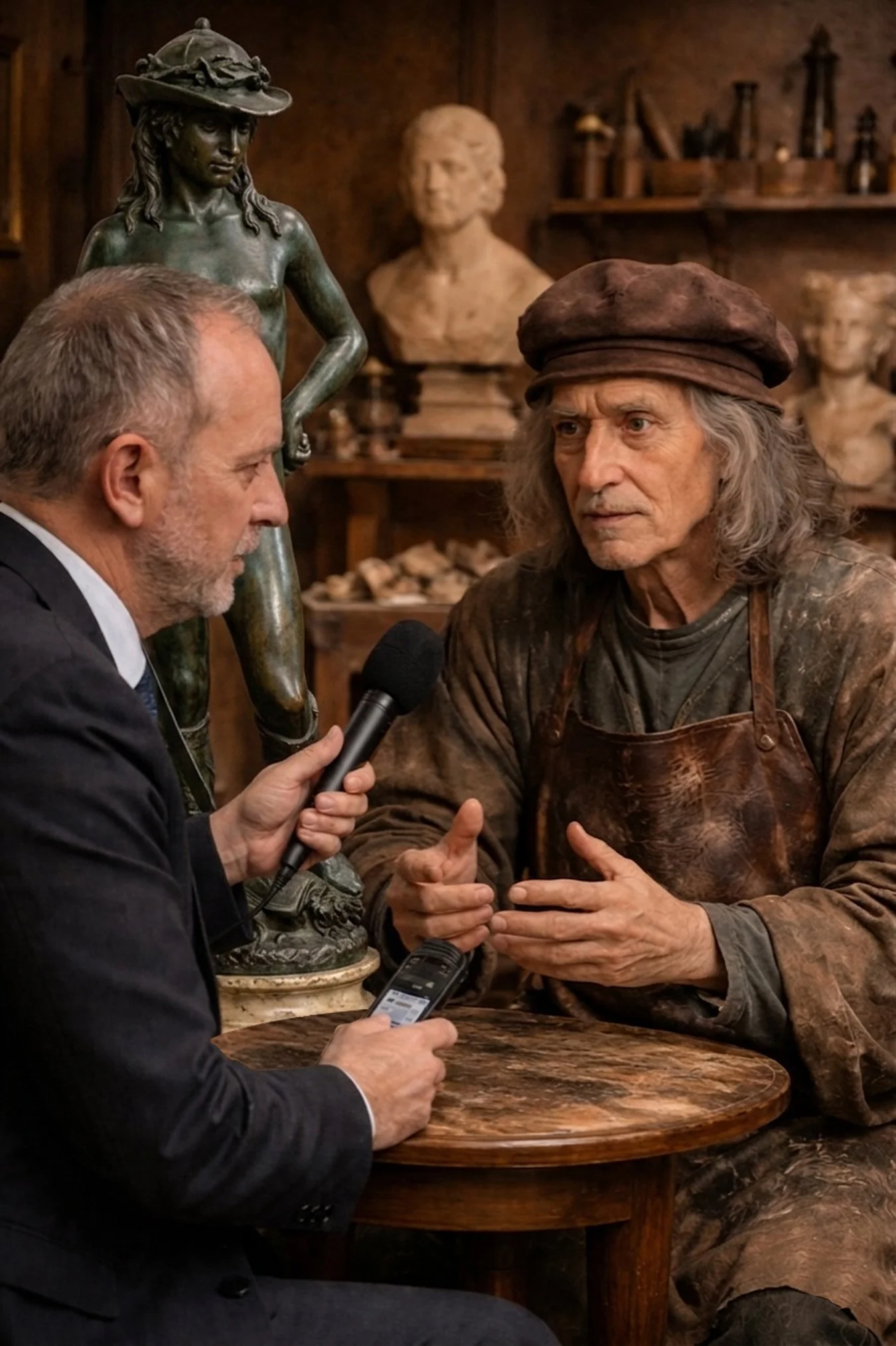
An ongoing series at stclaireart.com in which we imagine sitting down with the greatest artists in history.
Me: Sir, you are considered the first great sculptor of the Renaissance — the man who essentially brought sculpture back to life after centuries of medieval stiffness. That's an enormous thing to be credited with. Does it feel accurate?
Donatello: I did not think of it in those terms while I was working. I thought of it as — the figures in the churches looked like they were waiting for something. Standing there, rigid, symbolic, patient. But people are not like that. People lean. People turn to look at something over their shoulder. People carry weight in their bodies — grief, pride, exhaustion. I wanted to make figures that had clearly just moved, or were about to.
Me: As if you'd caught them mid-thought.
Donatello: Yes. Exactly that. Stone should not look like it is pretending to be alive. It should look like it was alive, just a moment ago.
Me: Your David was the first free-standing bronze sculpture since antiquity. That must have felt like an act of some courage — or perhaps defiance?
(He considers this with a slight tilt of the head.)
Donatello: Courage implies I was afraid. I was not afraid. I was — impatient. The human body is the most extraordinary structure in existence. Every muscle has a reason. Every gesture tells a story. To swathe all of that in heavy cloth, to hide the figure beneath layers of fabric and piety and frozen expression — it felt like a kind of lie. The Greeks understood that the unadorned form was not shameful but revelatory. I simply remembered what they knew.
Me: You simply remembered. Hah! You make it sound effortless.
Donatello: Well…It was not effortless. The bronze alone nearly killed me. I mean that in a practical sense — the casting, the heat, the fumes. But no, it was not effortless.
Me: If I may ask, what do critics and historians get most wrong about you?
Donatello: They place me in a line — before Michelangelo, before Raphael — as if I am a stepping stone to something else. A precursor. Well, no disrespect to either Michelangelo or Raphael but I was not working toward someone else's destination. I was working toward my own. The Magdalene — the wooden Magdalene I made near the end of my life — that is not a precursor to anything. That is a very old man looking very directly at suffering and not flinching.
Me: That piece is devastating. She looks almost destroyed.
Donatello: She had been destroyed. That is the point. Beauty was gone. Faith had cost her everything. I was not interested in making her pretty. I was interested in making her true.
Me: You worked in marble, bronze, wood, terracotta — you were endlessly restless in your materials. Was there one you loved above the others?
Donatello: Bronze. Always bronze. Marble is noble but it is cold and it is unforgiving — one wrong stroke and you have lost everything. Bronze lets you think in a different way. You build it up, you work in wax first, you can change your mind. And when it is finished it holds light in a way nothing else does. It breathes differently depending on the hour of the day.
Me: You sound like you're describing a person.
Donatello: (A pause. Then, quietly.) Yes. I suppose I do.
Me: If you had one day in the present — our world, right now — what would you do first?
Donatello: I would go to a place where they make things with metal. A factory, perhaps, or whatever you call them now. I want to see what tools exist. I spent half my life fighting my materials — the limitations of what a chisel could do, what fire could do. I want to know what I could have made with better instruments.
Me: And after that?
Donatello: (Without hesitation.) I would find the Magdalene and sit with her for a while. She is in Florence still?
Me: She is. In the Museo dell'Opera del Duomo.
Donatello: Good. She should stay in Florence. Some things belong where they were made.
Me: One last question for you…What, would you say, is art actually for?
Donatello: To tell the truth about what it feels like to be alive. Not what it looks like — anyone can describe what something looks like. But what it feels like. The weight of a decision. The way the body carries sorrow differently than it carries joy. I was never interested in ideals. I was interested in specifics. This man, this moment, this particular kind of pain or pride or tenderness. If a sculpture makes you feel something you have not felt before — or feel something you have felt but never seen reflected back at you — then it has done its work.
Donatello (c. 1386–1466) was a Florentine sculptor widely regarded as the greatest sculptor of the fifteenth century and one of the founding figures of the Renaissance. Working in marble, bronze, wood, and terracotta, he revolutionized European sculpture by reintroducing naturalism, psychological depth, and the free-standing nude. His best known works include David, the first free-standing nude bronze since antiquity, and the wooden Mary Magdalene, one of the most emotionally raw works of the Renaissance.
This is an imagined interview. Donatello's responses are constructed from historical research, contemporary accounts, and close study of his body of work. No direct quotes are presented as real.
No deceased artists were harmed in the making of this series.