
Conversations Across Time: Sandro Botticelli
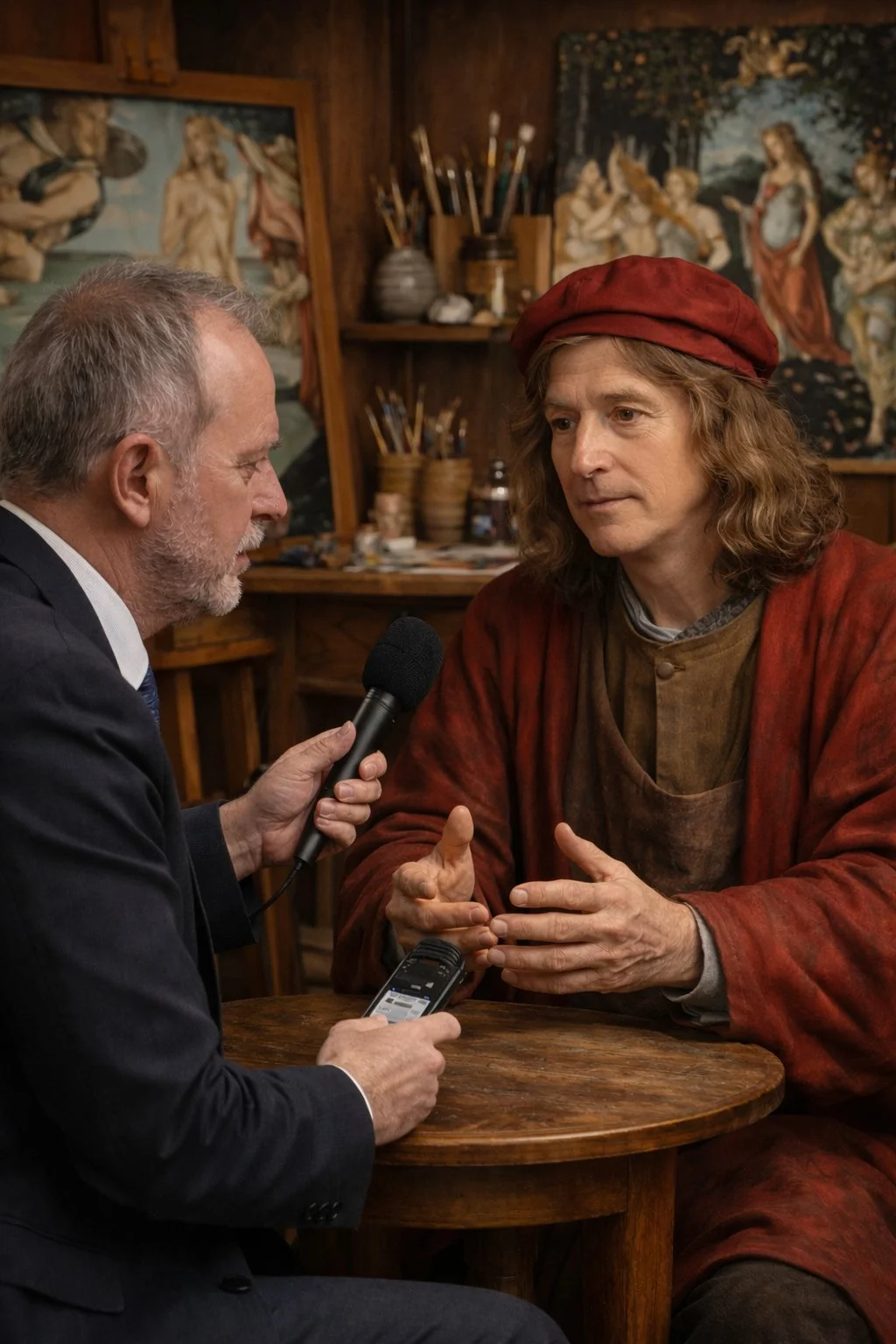
An ongoing series at stclaireart.com in which we imagine sitting down with the greatest artists in history.
Me: Master Botticelli, it is truly and honor to meet you. Thank you for your time. To begin with, I wanted to ask you about your painting “The Birth of Venus”. That piecewas considered scandalous when it was made — a life-sized goddess with nothing between her and the viewer but paint and air, the first such figure on that scale since antiquity.
Botticelli: Nervous is not quite the word. I was aware that I was doing something that had not been done for a very long time. But the Medici understood what I was trying to say. Lorenzo and his circle — they believed that beauty itself was a form of truth, that the ancient world had something to teach us about the divine that the Church had not entirely captured. Venus rising from the sea is not a pagan provocation. She is an idea. The arrival of beauty into the world. The soul descending into matter.
Me: That's a very philosophical defense of painting a gorgeous woman with nothing left to the imagination.
Botticelli: (Laughing softly.) Yes, well. Philosophy and beauty have always gotten along rather well.
Me: You were deeply connected to the Medici family and their circle of humanist philosophers. How much did that world shape what you painted?
Botticelli: Entirely. I cannot overstate it. Marsilio Ficino, Poliziano — these were men who spent their lives thinking about Plato, about the nature of love and beauty and the soul. I sat with them, listened to them, argued with them over dinner. When I painted Primavera — the three Graces, Mercury, Flora — I was painting their conversations. Their ideas given flesh and color and movement. Without the Medici I would have painted Madonnas for churches my whole life. They gave me permission to imagine a larger world.
Me: Do you think that was a gift or a complication?
Botticelli: (A pause.) Both. Always both.
Me: What would you say that critics and historians probably get most wrong about you?
Botticelli: They divide my life in two — the early Botticelli, full of beauty and mythology and light, and the later Botticelli, dark and religious and haunted. As if I became a different person. But I did not become a different person. The world became a different place. When Savonarola came, when Lorenzo died, when the bonfire of the vanities consumed so much of what we had made and loved — you could not simply continue painting spring goddesses as if none of that had happened. My later work is not a retreat. It is an honest response to loss.
Me: You reportedly burned some of your own paintings in Savonarola's bonfires.
Botticelli: (Quietly.) I was afraid. And I believed, for a time. I am not proud of the fear. The belief — that I understand better now, from a distance. But the fear I regret.
Me: The faces in your paintings — Venus, the Madonna, the Graces — they all share a certain quality. A kind of wistful melancholy even in moments of beauty. Was that deliberate?
Botticelli: I think beauty without some sadness in it is not entirely trustworthy. A face that is only happy is a face that has not yet understood what it means to be alive. The women I painted — they are beautiful, yes, but they are also aware of something. Some knowledge just at the edge of their expression. I could not paint innocence without also painting its fragility.
Me: Some people believe you were in love with Simonetta Vespucci — the woman thought to be the model for Venus. Were you?
Botticelli: (A long silence.) She was — there are some things a painter puts into his work precisely because he cannot put them anywhere else.
Me: That might be the most romantic answer I've ever received.
Botticelli: (Simply, without drama.) She died at twenty-three. I asked to be buried at her feet. Draw your own conclusions.
Me: If you had one day in the present — our world, right now — what would you do first?
Botticelli: I want to see what became of Florence. I know it is still there — I have heard it described. But I want to walk across the Ponte Vecchio and see if it still smells the same in the morning. I want to see whether the light on the Arno is as I remember it.
Me: I think you'd find it remarkably unchanged in some ways.
Botticelli: (Something in his face softens.) Good. Some things should be allowed to stay.
Me: And last question…What is art actually for?
Botticelli: I think the main goal of the artist is to make the invisible visible. Love, longing, the presence of the divine, the passing of time — none of these things have a shape you can point to. But a painting can give them a shape. When people stand before The Birth of Venus and feel something they cannot name — that nameless thing is the point. I was not painting a woman emerging from a shell. I was painting the moment beauty enters a life and changes it forever. If even one person has stood before that canvas and felt that — felt it in their body, not just understood it in their mind — then the painting has done what I asked of it.
Sandro Botticelli (1445–1510) was a Florentine painter of the early Renaissance, celebrated for his lyrical mythological works and his luminous Madonnas. A favorite of the Medici family, he moved in the most sophisticated intellectual circles of his age. In later life, under the influence of the fiery preacher Savonarola, he turned away from mythology toward intensely devotional religious work. His best known paintings include The Birth of Venus and Primavera.
This is an imagined interview. Botticelli's responses are constructed from historical research, contemporary accounts, and close study of his life and work. No direct quotes are presented as real.
No deceased artists were harmed in the making of this series.