
Conversations Across Time: Michelangelo
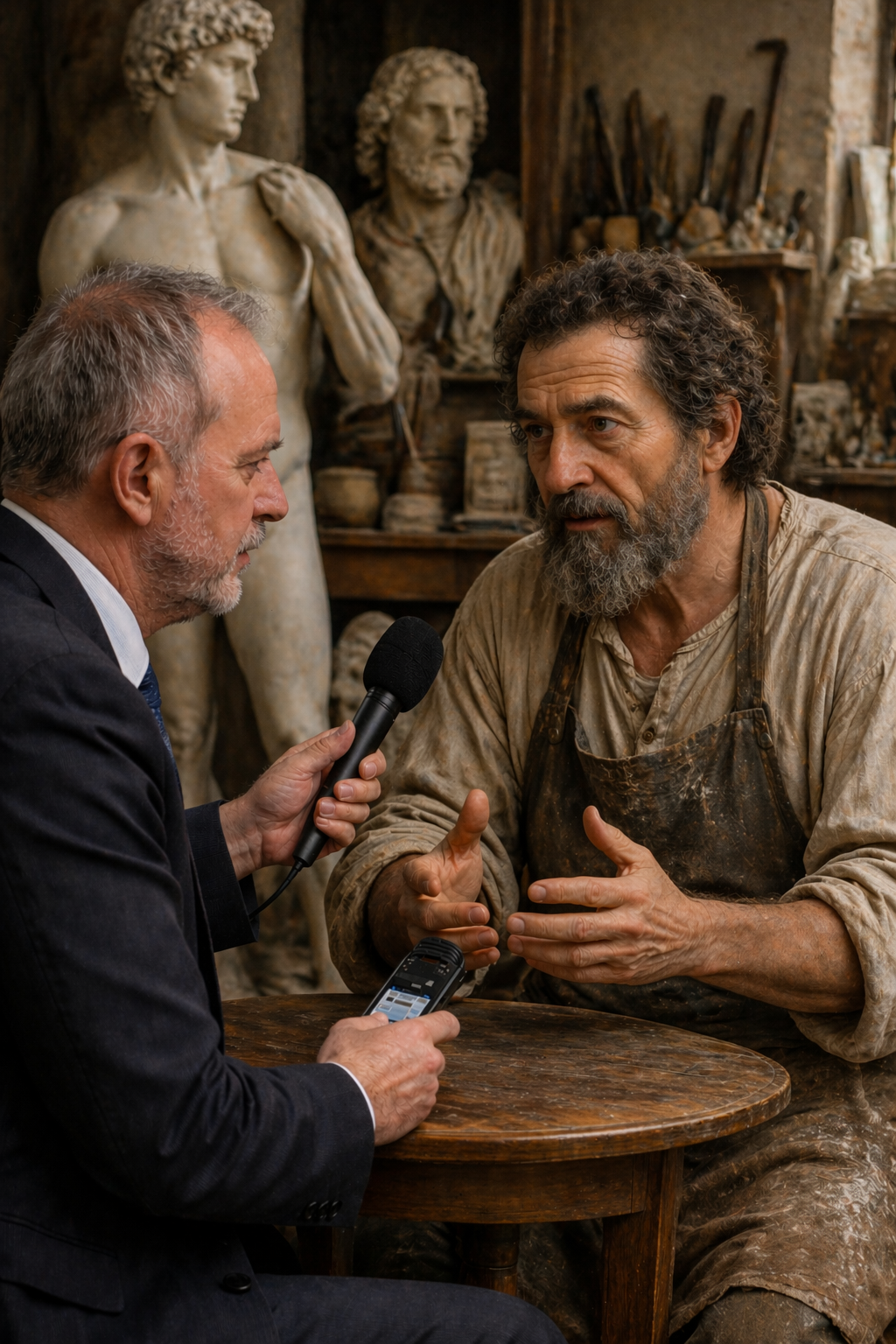
An ongoing series at stclaireart.com in which we imagine sitting down with the greatest artists in history.
Me: We're sitting in your studio in Rome. There is marble dust on everything, including you. You've been working this morning already.
Michelangelo: I am always working. Ask your questions.
Me: I will do that. First of all, you are perhaps the only artist in history who was called "divine" during his own lifetime. How did you carry that?
Michelangelo: Badly, I think. (He says this without humor.) It is a dangerous thing to be told you are divine when you are also a man who sleeps poorly and quarrels with his patrons and worries about money. The gap between what people believed I was and what I knew myself to be — that gap was not comfortable to live inside. I was not divine. I was someone who worked. I could not stop working even when it was killing me.
Me: And it nearly did, several times.
Michelangelo: The Sistine ceiling alone — four years on my back, the paint dripping into my eyes, my neck so damaged I could not hold my head straight for months afterward. Pope Julius would bang on the door and demand to know when it would be finished. I wanted to throw him from the scaffolding on more than one occasion.
Me: I'd have paid to see that.
Michelangelo: (The ghost of a smile.) So would I.
Me: You always insisted you were a sculptor first, not a painter. Yet the Sistine Chapel ceiling is arguably the most famous painted surface in the world. Does that irk you?
Michelangelo: Irk is too small a word. I was given a ceiling and told to paint apostles in the corners. Apostles in the corners! I looked at that ceiling and I saw — everything. The whole story of man and God and creation and failure and redemption. So I painted everything. And now people come from every corner of the earth to lie on their backs and look up and they do not know — they cannot know — what it cost.
Me: What did it cost?
Michelangelo: (A long pause.) I wrote a poem about it at the time. About my body twisted and ruined, paint falling on my face like a floor. I meant it as a complaint. People now read it as a testament. (Drily.) That seems about right.
Me: What do critics and historians get most wrong about you?
Michelangelo: They romanticize the suffering. They think the torment was the source of the genius — that I had to be miserable to make beautiful things. This is nonsense. I was miserable because the work was hard and the patrons were difficult and the marble was sometimes wrong and the human body refused to do what I asked of it. The suffering was not the point. The work was the point. I would have preferred to be happy and make the same things. I was simply not given that option.
Me: Were you ever happy?
Michelangelo: (He thinks about this with what seems like genuine effort.) There were moments inside the work. When something resolved — when a figure finally did what I had been trying to make it do for weeks — there was something in that. Not happiness exactly. Relief, perhaps. The relief of a problem solved.
Me: The Pietà — you made it when you were twenty-four years old. Twenty-four. How?
Michelangelo: I had been looking at it my whole life. Every pietà I had ever seen was wrong — the Virgin too old, too grief-stricken, the composition fighting itself. I knew what it should be before I touched the marble. Mary had to be young — ageless, really. Grief of that magnitude does not age a person. It suspends them. And Christ had to lie across her with the full weight of what had been lost — not the weight of a body, but the weight of the world. The marble told me the rest.
Me: "The marble told you." You've said that before — that the figure already exists inside the stone.
Michelangelo: It is not mysticism. It is attention. You look at the block long enough, you see where it wants to go. The sculptor's job is simply to remove what does not belong.
Me: If you had one day in the present — our world, right now — what would you do first?
Michelangelo: I would go to Disneyland. Hah! Just kidding. I would definitely go to the Accademia in Florence and stand before the David for as long as they would allow me. Not out of vanity — I want to see what time has done to him. Whether he still holds. Whether the tension in the shoulders reads the way I intended across five hundred years.
Me: He still stops people in their tracks.
Michelangelo: (Quietly, as if to himself.) Good. He should. He is about to do something terrifying and he knows it and he is going to do it anyway. That is the whole of it. That is what I put into the marble.
Me: What is art actually for?
To close the distance between the human and the divine. I do not mean this in a soft or decorative sense. I mean it literally. We are imperfect creatures living imperfect lives and we sense — we cannot help but sense — that there is something larger than us, something that does not decay the way we decay. Art is the attempt to touch that thing. To make something that participates in permanence even briefly. The Sistine ceiling will outlast everyone who has ever stood beneath it. That is not nothing. That is, in fact, almost everything.
Michelangelo di Lodovico Buonarroti Simoni (1475–1564) was a Florentine sculptor, painter, architect, and poet widely considered one of the greatest artists of all time. Fiercely devout, famously difficult, and relentlessly prolific, he worked into his eighties and left behind a body of work that remains without parallel. His best known works include the Pietà, theDavid, and the ceiling of the Sistine Chapel in Rome.
This is an imagined interview. Michelangelo's responses are constructed from historical research, his own surviving letters and poems, and contemporary accounts of his life and personality. No direct quotes are presented as real.
No deceased artists were harmed in the making of this series.