
Conversations Across Time: Raphael
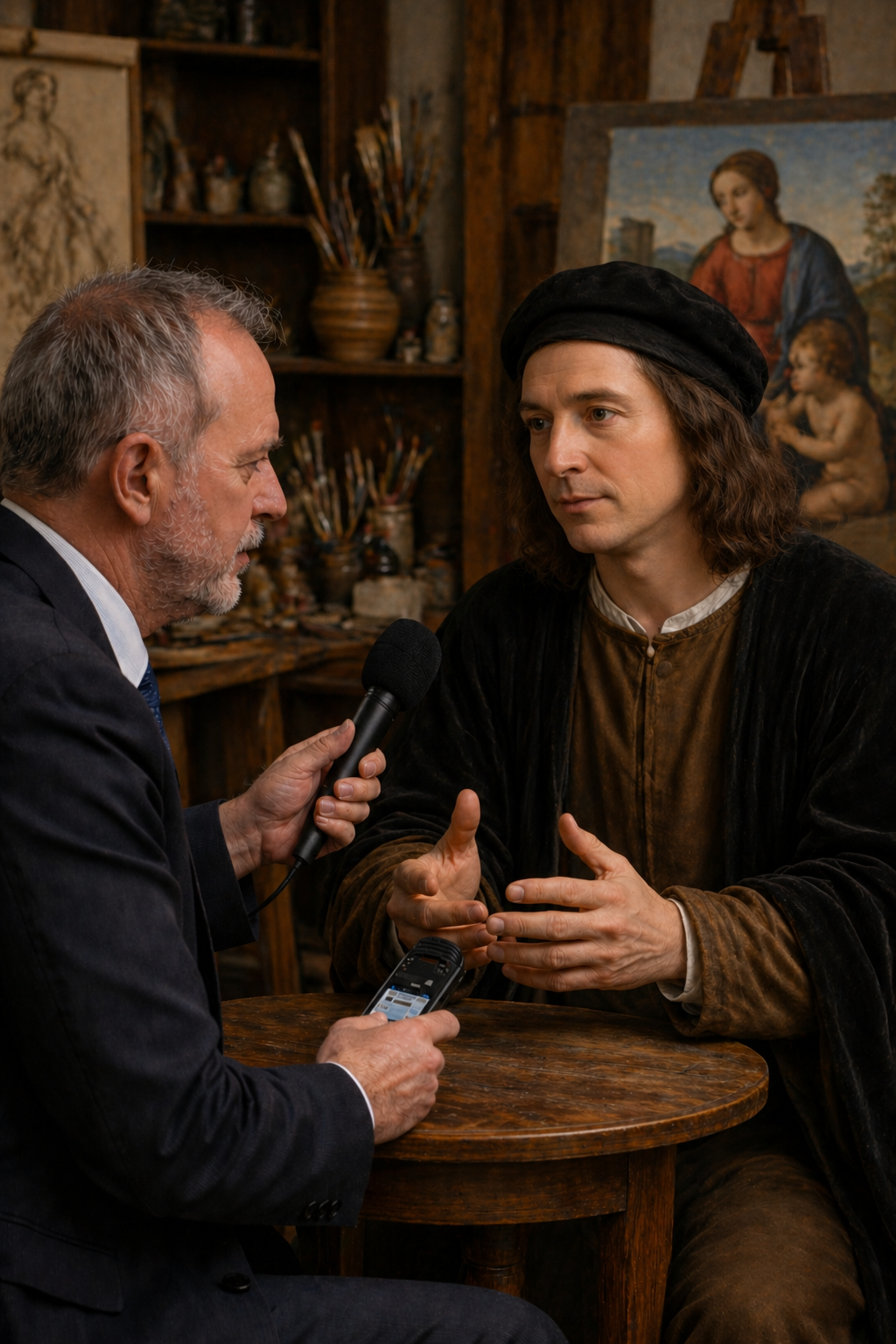
An ongoing series at stclaireart.com in which we imagine sitting down with the greatest artists in history.
When I set up this interview, I was invited to meet in Rome, in a studio that felt less like a workplace and more like a gathering place — assistants moving quietly in the background, light pouring through high windows. The master stood to greet me before I even sat down. He is younger looking than I expected.
Me: You're more relaxed than the last few people I've sat with in this series.
Raphael: (Laughing.) Who have you been talking to? Michelangelo?
Me: Among others.
Raphael: Then I am not surprised. Sit down. Can I offer you anything?
Me: You died at thirty-seven. In those thirty-seven years you produced a body of work that most artists couldn't match in a hundred. Did you have some sense that time was short?
Raphael: I had a sense that there was always more to do than time allowed. Whether I knew how little time I had — no. I don't think any of us knows that. But I worked quickly because I loved working. It was not anxiety that drove me. It was appetite. Every commission was a new problem, a new room, a new surface, a new set of ideas to wrestle with. I found that — I find that — I cannot think of anything I would rather be doing.
Me: Even now, knowing how it ends at thirty-seven?
Raphael: (A pause, something flickering across his face.) Even now. The work was the life. The life was the work. I have no complaints about what I was given.
Me: You were a student of Perugino, and then you came to Florence and encountered Leonardo and Michelangelo. That must have been like walking into a thunderstorm.
Raphael: That is exactly what it was. I arrived thinking I knew something — Perugino had taught me well, I was already receiving commissions — and then I saw what Leonardo was doing with shadow, what Michelangelo was doing with the human form, and I understood very quickly that I needed to start over.
Me: That kind of humility is rare, sir.
Raphael: It was not humility. It was clarity. There is no point in pretending you are further along than you are. I looked at the cartoon for the Battle of Anghiari and I thought — I cannot do that yet. So I learned how. A painter who cannot be changed by what he sees has stopped growing. I never wanted to stop growing.
Me: What do critics and historians get most wrong about you?
Raphael: That I was somehow easier than the others. Smoother. More decorative. As if grace and harmony are lesser achievements than struggle and torment. Michelangelo suffered visibly and so people decided his work must be deeper. I made it look effortless and so people decided it must have been. Neither is true, of course. The School of Athens alone — the architecture, the fifty-eight figures, each one a specific philosopher with a specific gesture and a specific relationship to every other figure in the room — that did not happen effortlessly. I simply did not see the point of making my difficulties your problem.
Me: That might be the most elegant thing anyone has said to me in this series.
Raphael: (Smiling.) I have had practice.
Me: You were enormously charming, socially gifted, beloved by popes and patrons alike. Was any of it an act?
Raphael: All of it and none of it. I genuinely liked people. I was genuinely interested in them. But I also understood very early that a painter who cannot get along with his patrons is a painter who does not work, and a painter who does not work is simply a person with ideas that go nowhere. The charm was real. The usefulness of the charm was also real. I saw no contradiction there.
Me: If you had one day in the present — our world, right now — what would you do first?
Raphael: I would go to the Vatican and stand in the Stanza della Segnatura and look at the School of Athens for as long as they would let me. I want to see it with modern eyes — with the distance of five hundred years. When you are inside the making of something you cannot see it whole. I never could. I want to finally see it whole.
Me: It is considered one of the greatest paintings ever made.
Raphael: (Quietly, and without vanity.) I know. I just want to see it for myself.
Me: And finally…What is art actually for?
Raphael: Interesting question. I think, art is for bringing people together around something larger than themselves. Look at the School of Athens — Plato and Aristotle at the center, every great mind of antiquity gathered in one imagined space, in conversation, in disagreement, in the shared pursuit of understanding. That is what art does at its best. It creates a room that everyone can enter. It says — here are the best things human beings have thought and felt and made. Come in. Sit down. You belong here too.
Raffaello Sanzio da Urbino (1483–1520), known as Raphael, was an Italian painter and architect of the High Renaissance whose work is celebrated for its clarity, grace, and visual achievement of the Neoplatonic ideal of human grandeur. Alongside Leonardo and Michelangelo he forms the triumvirate of the great masters of that period. He died in Rome on his 37th birthday, widely mourned. His best known works include The School of Athens and the Sistine Madonna.
This is an imagined interview. Raphael's responses are constructed from historical research, contemporary accounts of his personality and working methods, and close study of his life and work. No direct quotes are presented as real.
No deceased artists were harmed in the making of this series.