
Conversations Across Time: Caravaggio
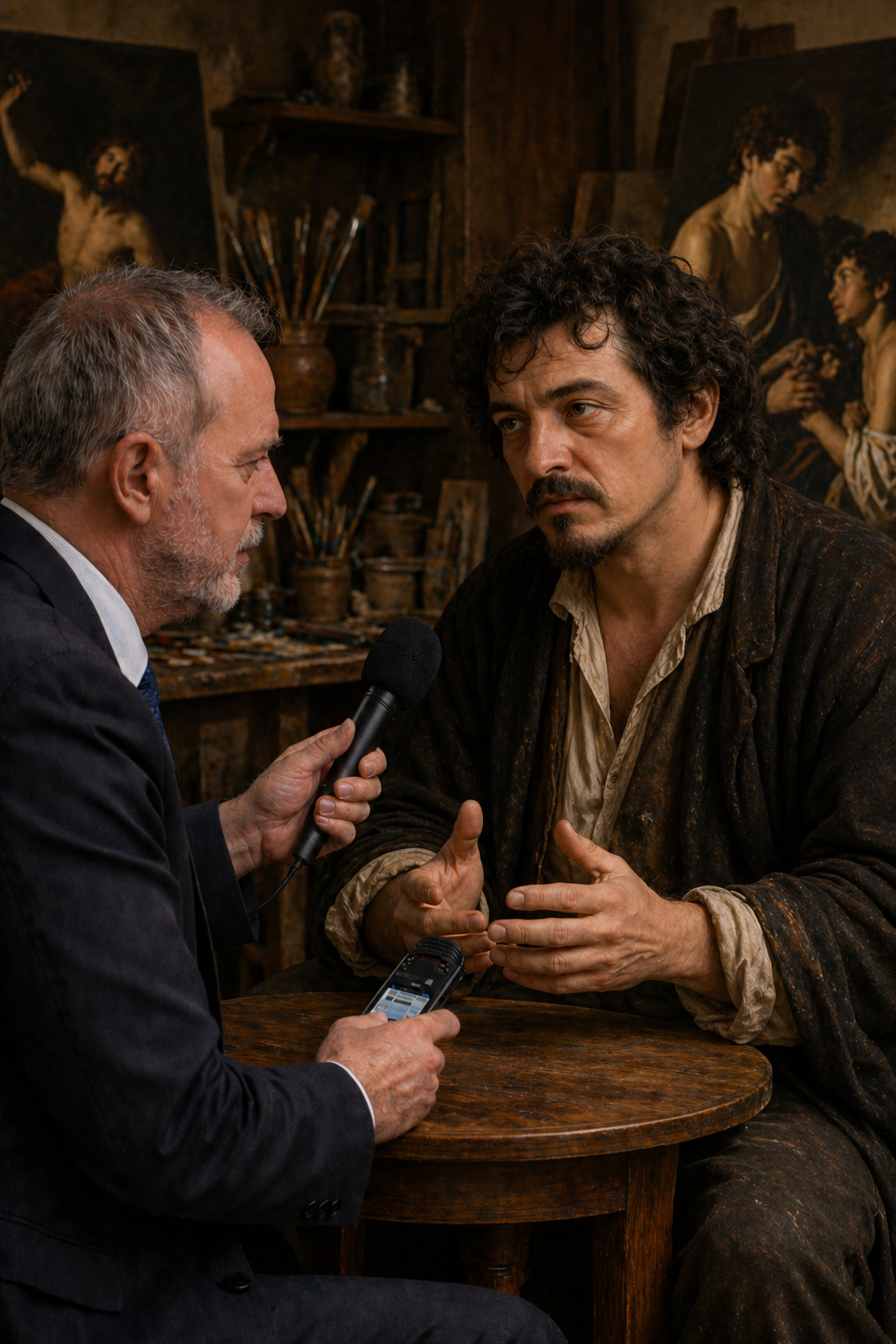
An ongoing series at stclaireart.com in which we imagine sitting down with the greatest artists in history.
This interview was interesting. This gentleman arrived looking like a man who has not slept well in years. He sat with his back to the wall, facing the door, and surveyed the room with the particular alertness of someone who has learned to be careful. It is 2026, though he does not seem entirely surprised to be here.
Me: I'll be honest — I wasn't sure you'd agree to this.
Caravaggio: (A short, hard laugh.) I have nothing but time at the moment. And I find I am tired of my own company. Ask your questions.
Me: You changed painting forever — the darkness, the light, the ordinary people pulled in from the streets to play saints and apostles. Where did that come from?
Caravaggio: From looking. From actually looking at the world rather than at other paintings. When I arrived in Rome every painter was painting other painters. Raphael painting Raphael painting Raphael. Beautiful, yes. True? No. I went into the streets. I found a prostitute and I painted her as the Virgin Mary. I found a peasant with dirty feet and I painted him as Saint Matthew. The Church was not always pleased.
Me: That's putting it mildly.
Caravaggio: (Drily.) They rejected the painting. Twice, in one case. But they always came back. Because people stood in front of those paintings and recognized something. They saw themselves. They saw their mothers, their neighbors, their own hands. That had not happened before, not like that. You cannot reject that forever, no matter how uncomfortable it makes you.
Me: The darkness in your work — the dramatic shadows, the figures emerging from almost pure black. Was that a technical choice or something more personal?
(A long pause. He looks at his hands.)
Caravaggio: Both. Always both. I understood very early that light means nothing without darkness. A face fully lit is a face with nowhere to hide. But catch it half in shadow and suddenly there is mystery — there is an interior life, something the viewer has to complete themselves. That is where the drama lives. In what you cannot quite see.
Me: Some people have suggested the darkness reflected your own psychology.
Caravaggio: Some people should paint their own pictures and leave mine alone. He paused. But they are not entirely wrong.
Me: You killed a man. In a brawl in Rome in 1606. You've been running ever since. Does it follow you into the work?
Caravaggio: Everything follows me into the work. That is both the gift and the punishment of being a painter. You cannot separate what you have lived from what you make. After Rome — after the killing — the paintings got darker. More desperate. More — I don't know the word. More aware of how quickly it can end. Look at the late work. Look at the David with the Head of Goliath. That is my own face on Goliath's severed head. I painted myself as the monster. As the defeated thing. Make of that what you will.
Me: That's an extraordinary act of self-examination.
Caravaggio: Or self-punishment. I have never been entirely sure which.
Me: What do think critics and historians get most wrong about you?
Caravaggio: They make the life the story and forget the work. Yes, I was violent. Yes, I fled Rome. Yes, I spent time in prison more than once. These things are true and I do not deny them. But I did not change the history of painting by being violent. I changed it by working. By getting up every morning — or every afternoon, I was never an early riser — and standing in front of a canvas and solving problems that no one had solved before. The life makes a good story. The work is the actual point.
Me: If you had one day in the present — our world, right now — what would you do first?
I want to see what became of the light. Photography, cinema — I have heard about these things. Capturing light on a surface, freezing a moment. (Something shifts in his face.) That is what I was trying to do. With paint, with a candle, in a dark room. I want to see if they understood what they were doing — if they knew they were continuing something that started in my studio in Rome.
Me: I think some of them knew exactly that.
Caravaggio: (Quietly, and with what might be satisfaction.) Good.
Me: And lastly, what would you say art is actually for?
Caravaggio: To show people what they are actually looking at. Not what they think they see — what is really there. A saint is a human being who was afraid and went forward anyway. A sinner is a human being who made a choice in a bad moment. I painted both with the same faces because they are the same people. Art strips away the comfortable story and shows you the truth underneath. That is not always a pleasant experience. It was never meant to be.
Michelangelo Merisi da Caravaggio (1571–1610) was an Italian painter whose revolutionary use of dramatic light and shadow — chiaroscuro — and his insistence on gritty, unidealized realism transformed Western painting and gave birth to the Baroque. Volatile, violent, and perpetually in trouble with the law, he spent the last years of his life in exile, dying under mysterious circumstances at thirty-eight, a papal pardon reportedly just days away. His best known works includeThe Calling of Saint Matthew, the Judith Beheading Holofernes, and David with the Head of Goliath.
This is an imagined interview. Caravaggio's responses are constructed from historical research, contemporary accounts of his personality and documented life events, and close study of his body of work. No direct quotes are presented as real.
No deceased artists were harmed in the making of this series.