
Art Blog
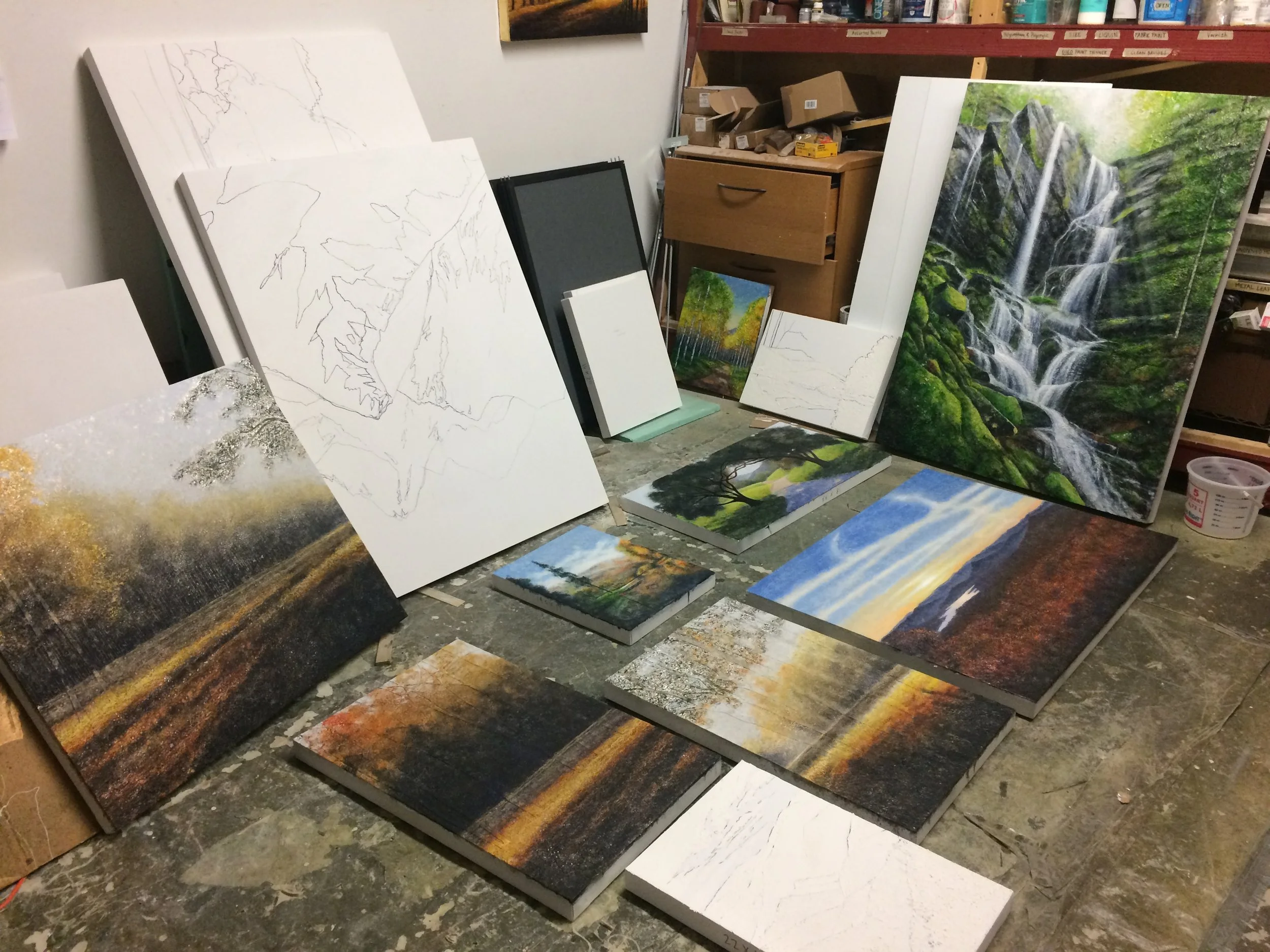
This blog is for posting photos of new artwork and for the expression of sometimes random thoughts of oil painter Stephen St. Claire.
Conversations Across Time: Claude Monet
An ongoing series at stclaireart.com in which we imagine sitting down with the greatest artists in history.
He arrives with the energy of a man who would rather be outside. He glances at the windows, assesses the quality of the light, and sits down with the slightly impatient air of someone who has agreed to this but has a garden to get back to.
Me: I should tell you — as a landscape painter myself, this particular conversation means a great deal to me.
Claude: (He looks at me with immediate interest, the impatience gone.) You paint outside?
Me: I do. Sometimes. It’s very relaxing.
Claude: Then you already understand most of what I am going to tell you. The rest I will explain anyway, for the others.
Me: You essentially invented a new way of seeing — capturing light and atmosphere rather than fixed forms. Did you know you were doing something radical?
Claude: I knew I was doing something true. Whether it was radical was other people's concern. What I could not accept was the lie of the fixed form. A cathedral is not a fixed thing. A haystack is not a fixed thing. They change from hour to hour, from season to season, from clear morning to foggy afternoon. To paint them as if they have one definitive appearance — one correct version — seemed to me a fundamental dishonesty about the nature of the world. The world is not still. Light is not still. Why should painting be?
Me: The Academy certainly had opinions about that.
Claude: The Academy had opinions about everything. Fortunately I had Camille, and then I had Alice, and then eventually I had Giverny, and I found I could manage without the Academy's opinions entirely.
Me: Giverny. The garden. I’ve been there and it is EXQUISITE. You spent the last thirty years of your life essentially painting the same pond. Was that obsession or contentment?
(He almost laughs.)
Claude: Neither. It was — understanding. I had spent fifty years chasing the light across Normandy, across London, across Venice. Always moving, always looking for the next thing. And then I made the garden and I realized the light had been the subject all along, not the places. And if the light was the subject I did not need to go anywhere. I had everything I needed in two acres in Normandy.
Me: That's a profound thing to discover at seventy.
Claude: It is a profound thing to discover at any age. Most people never discover it at all.
Me: You lost your sight toward the end of your life — cataracts that blurred and yellowed everything you saw. You kept painting anyway. How?
Claude: What else would I do? Stop? (A pause, and something more vulnerable surfaces.) I knew what I was losing. I could see the colors shifting, the blues going, the whole palette becoming muddy and orange. There were paintings from that period I later destroyed because I could not trust what I had seen. But I kept working because the alternative was — there was no alternative. A painter who does not paint is not a painter. He is simply a person who used to do something.
Me: The Water Lilies from that period — the large ones, the ones that wrap around an entire room — they look like nothing else ever painted.
Claude: (Quietly.) I know. I could not see clearly and I painted something I had never seen before. I do not entirely know what to make of that.
Me: What do critics and historians get most wrong about you?
Claude: That Impressionism was about softness. About pretty light on pretty water. People come to my paintings expecting to be soothed and I understand why — they are not wrong exactly. But what I was doing was not decorative. I was trying to capture something genuinely difficult — the exact quality of light on water at a specific moment on a specific day that will never come again exactly that way. That is not soft. That is precise. It is a different kind of precision than the Academy wanted, but it is precision nonetheless.
Me: If you had one day here — in this world, in 2026 — what would you do first?
Claude: I want to see the Orangerie. The large Water Lilies panels — I donated them to France just before I died and I never saw them properly installed. I want to stand in the center of that oval room and see what they look like when they surround you completely. That was what I intended. I never got to see if it worked.
Me: It works. People stand in that room and go completely silent.
(He is quiet for a moment. Something moves across his face.)
Claude: Good. Silence was always what I was after. Not the silence of emptiness — the silence of complete attention. If people are silent in that room it means they are actually looking. That is all I ever wanted.
Me: What, in your own mind, is art actually for?
Claude: For teaching people to see. Not to look — to see. I spent my whole life learning to see light as it actually is rather than as I had been told it was. The shadows on snow are not gray — they are violet and blue. The water in the pond is not blue — it is the sky and the trees and the clouds and the morning, all at once, always moving. Once you really see that — once you cannot unsee it — the world becomes almost unbearably beautiful. Art at its best does that. It changes what you are capable of seeing. And once your vision is changed, it does not change back.
Oscar-Claude Monet (1840–1926) was a French Impressionist painter and one of the founders of the Impressionist movement, whose insistence on painting the transient effects of light transformed Western art. He worked outdoors throughout his career, painting in series to capture the same subject under different conditions of light and season. In his final decades he created the garden at Giverny and produced the monumental Water Lilies series, working nearly blind, in what many consider the most extraordinary final chapter in the history of art. His best known works include Water Lilies, the Haystacks series, and Rouen Cathedral.
This is an imagined interview. Monet's responses are constructed from historical research, his surviving letters and documented statements, and close study of his life and work. No direct quotes are presented as real.
No deceased artists were harmed in the making of this series.
Parting Thoughts
I’ve had a month now to process my time in Japan, and honestly, I've only just begun. There are so many things I saw that utterly baffled and humbled me, but if I could boil it all down to one realization, it would be the primary position that Japanese culture gives to beauty.
Let me explain.
We saw and enjoyed many national gardens while we were there. They were gorgeous, and I could have spent hours exploring them. But they were not surprising to me; I expected them (I'd seen the Instagram photos, after all!). What actually astounded me can be aptly illustrated by a scene on the edge of the town of Kutchan, on the northern island of Hokkaido.
Kutchan is a fairly nondescript town, except for the gorgeous volcano in its backyard—Mount Yotei, a striking Fuji lookalike. While this area bustles during the winter ski season, we visited in the early summer, so there were very few tourists around. One afternoon, Joy and I rented e-bikes and spent the day riding the quiet roads winding across the volcanic plain.
As we rode back toward town late in the afternoon, we stopped outside one of the very first houses we encountered. The house itself was nothing to note, but the garden... the garden was absolutely exquisite. It wasn't large, but every single inch of it was lovingly tended. Flowers, sculpted trees, mossy rocks—it was unbelievably beautiful.
And here is what hit me: I was in a quiet town, on an out-of-the-way little street, standing in front of an ordinary house with a miniature garden that felt like a microcosm of Eden itself. As an American, the question that kept running through my mind was why? I mean, it's one thing to have a garden, but this? What I saw went far beyond "over the top." Why bother? Who was ever going to see this? It wasn’t as if this garden sat outside a landmark home on the main street next to the "Welcome to Kutchan" sign.
So, why do it? Why go to all the trouble? Why spend hours pulling individual dead leaves off of trees as they begin to fade? I literally saw people on ladders, gently removing dead pine needles and shaping branches with tiny scissors. The attention to detail and the deliberate cultivation of beauty was at a level I have truly never seen before.
Why? Because beauty is treasured simply because it is beautiful. It’s circular reasoning, but it works.
This realization hit me hard, and it directly affects my view of who I am and what matters most. Every time we look at the chaos in the world around us and call beauty into existence—even in the smallest, quietest of ways—we are doing truly holy work. Whether what we create is noticed by thousands or by no one at all, it matters. It matters because we made it, and it matters because beauty is beautiful. It is a lesson I’m carrying back to my own creative practice: to clear away the noise, focus on the details, and simply build something beautiful for its own sake.
A quiet green space,
Tended for no eyes but God’s,
Beauty is enough.
Conversations Across Time: Johannes Vermeer
An ongoing series at stclaireart.com in which we imagine sitting down with the greatest artists in history.
He arrives without ceremony and sits down with the quiet ease of a man who is accustomed to watching the world rather than performing for it. He is younger than you expected. He looks at the light coming through the window for a long moment before he looks at you.
Me: I have to be honest with you — you are one of the hardest people in this series to prepare for. You left almost nothing behind. No letters, no diaries, no accounts of your personality. You are almost entirely your paintings.
Vermeer: (He considers this without apparent discomfort.) Perhaps that is as it should be.
Me: That's a very elegant deflection.
Vermeer: It is not a deflection. I mean it. A painter who needs to explain himself outside the work has not finished the work. Everything I had to say I said in the paintings. If they are not enough, more words will not help.
Me: You painted almost exclusively in one room. The same window, the same north light, the same corner of Delft for most of your career. Was that a limitation or a choice?
Vermeer: A discovery. I found early that the further you narrow your world the deeper you can go into it. That window — the way the light came through it in the morning, the way it changed from season to season, the way it fell differently on silk than on linen than on skin — I could spend a lifetime studying that and not exhaust it. Most painters travel the world looking for their subject. I found mine in one room and stayed there.
Me: And you found infinity in it.
Vermeer: (Quietly.) I found enough. That is better than infinity. Infinity is overwhelming. Enough is — sufficient. Perfect, even.
Me: Your figures are almost always caught in private moments — reading a letter, pouring milk, playing music. Always alone, or unaware of being watched. Why that quality of privacy?
Vermeer: Because that is when people are most themselves. The moment someone knows they are being observed they begin to perform. Even slightly, even unconsciously — they adjust. I was interested in the unguarded moment. The woman reading the letter does not know I am there. Whatever that letter contains — joy, grief, news from far away — it is entirely hers. I am only a witness. A very quiet one.
Me: There's something almost voyeuristic about it.
Vermeer: There is something voyeuristic about all painting. I simply did not pretend otherwise.
Me: What do critics and historians get most wrong about you?
Vermeer: They are so occupied with the mystery of me that they sometimes forget to look at the paintings. I understand the appeal — so little is known, the life is a puzzle, the question of the camera obscura, the question of how I achieved the light. But the paintings are not puzzles. They are very clear. A woman stands at a window. The light falls on her. Something is happening inside her that we cannot quite name. That is not mysterious. That is simply true. That is what people are like. We are all standing at windows with things happening inside us that we cannot quite name.
Me: That might be the most precise description of the human condition I've heard in this series.
Vermeer: (A slight smile.) I had thirty-four paintings to work it out in. It took a while.
Me: And…if you had one day here — in this world, in 2026 — what would you do first?
Vermeer: I would want to see what became of the light. Not painting — light itself. I have heard there are cities now that never go dark. I find that — I am not sure how I feel about that. Light without darkness seems to me like silence without sound. Each requires the other to mean anything.
Me: You'd probably find it overwhelming.
Vermeer: (Simply.) I would find a quiet room with one window and sit in it until I understood where I was. That is what I always did.
Me: Lastly, what would you say art is actually for?
Vermeer: For paying attention to what is actually there. Not the grand gesture, not the historical moment, not the king on his throne — the milk pouring from a jug. The letter held in two hands. The pearl at a woman's ear catching light for a fraction of a second in a room in Delft in 1665. These things happened. They were real. Without the painting they would have vanished utterly — the woman, the light, the moment, all of it gone as if it never was. Art says: this was here. This was real. Someone saw it and thought it worth the full weight of their attention. I cannot imagine a more important thing to say.
Johannes Vermeer (1632–1675) was a Dutch Golden Age painter who worked almost exclusively in Delft, producing a small body of work — thirty-four or thirty-five paintings survive — of such luminous perfection that he is now considered one of the greatest painters in history. Almost nothing is known of his personal life. He died at forty-three, leaving his wife and eleven children in debt. His best known works include Girl with a Pearl Earring, the Milkmaid, and Woman Reading a Letter.
This is an imagined interview. Vermeer left almost no personal writings, and his responses here are constructed from historical research, close study of his paintings, and what the work itself suggests about the man who made it. No direct quotes are presented as real.
No deceased artists were harmed in the making of this series.
Conversations Across Time: Rembrandt van Rijn
An ongoing series at stclaireart.com in which we imagine sitting down with the greatest artists in history.
He arrives looking older than his years — which, given everything he lived through, makes complete sense. There is nothing grand about his entrance. He sits down heavily, looks at me directly, and waits. His eyes are remarkable. I get the sense he has been studying my face since the moment he walked in.
Me: You painted yourself more than any other artist in history. Nearly a hundred self-portraits over fifty years. Why?
Rembrandt: Because I was always available. (A short laugh.) And because I was the most interesting subject I had access to. Not because I was vain — I think the self-portraits make clear I was not vain. I painted every line, every fold of fat, every year that landed on my face. A vain man does not do that.
Me: Then what does a man who does that want?
Rembrandt: To understand what he is looking at. I painted myself at twenty and at sixty and at everything in between. I wanted to see what time does to a person. What loss does. What failure does. I was also, I think, trying to catch something — some essential thing underneath the face that stays the same even as everything else changes.
Me: Did you ever find it?
(A long pause.)
Rembrandt: Come back to me at the end of the interview.
Me: You were enormously successful in your thirties — wealthy, celebrated, the most sought-after portrait painter in Amsterdam. And then it all collapsed. Bankruptcy, the death of your wife, your house sold off. How did you survive it?
Rembrandt: I painted. There was nothing else to do. And I will tell you something that sounds strange — the work got better. Not because suffering is good for a painter, I do not believe that. But because after the bankruptcy, after Saskia died, I had nothing left to protect. No reputation to maintain, no wealthy clients to please, no position to guard. I could paint exactly what I saw. That freedom was — I did not choose it. But I used it.
Me: There's something almost liberating in having nothing left to lose.
Rembrandt: Almost. (Quietly.) Not entirely.
Me: Your use of light is unlike anyone else's — it seems to come from inside the figures rather than falling on them from outside. How did you think about light?
Rembrandt: I thought about it the way you think about something you cannot stop thinking about. Light is not decoration. Light is meaning. Where I put the light is where I am telling you to look — not just with your eyes but with your whole attention. And the darkness around it is not empty. The darkness is full of everything I am not telling you. The viewer's imagination fills it. That collaboration — between what I show and what I withhold — that is where the painting lives.
Me: Caravaggio did something similar with shadow.
Rembrandt: Caravaggio used darkness dramatically. I used it — intimately. There is a difference.
Me: What do critics and historians get most wrong about you?
Rembrandt: They make the tragedy the explanation. As if the bankruptcy and the losses produced the depth. But I was painting with that depth before any of it happened. Look at the early work — it is already there. The losses did not create the sensitivity. They confirmed it. Sharpened it perhaps. But a man who did not already see the world that way would not have been destroyed by those losses. He would simply have moved on. I could not move on. I never could. That was always true.
Me: If you had one day here — in this world, in 2026 — what would you do first?
Rembrandt: I want to see the late self-portraits. The ones from the last years. I could not see them clearly when I was making them — you never can. I want to stand in front of them now, with distance, and see what I was actually saying.
Me: They are considered among the most moving paintings ever made. There's one in particular — the laughing self-portrait — that people find almost unbearable in its humanity.
Rembrandt: (He is quiet for a moment.) I remember that one. I was not performing the laugh. It simply — arrived. I had been sitting there for a long time and something struck me as funny. I do not remember what. I painted it before it left.
Me:That might be the most human thing anyone has said to me in this entire series.
Rembrandt: (Simply.) We are all just trying to catch the thing before it leaves.
Me: What is art actually for?
Rembrandt: For seeing people. Truly seeing them — not the role they play, not the face they show the world, but the interior life behind the eyes. I painted merchants and ministers and old women and my own aging face, and I tried every time to find the person inside the occasion. That is what art is for. To insist that every human being — regardless of their station, their beauty, their success or failure — is worth that quality of attention. That they contain something worth finding. I believe that. I believed it when I was rich and I believed it when I had nothing. It is the one thing that did not change.
Me: You never answered my first question. Did you ever find it — that essential thing underneath the face that stays the same?
Rembrandt: (He looks at you for a long moment.) Yes. But I am not sure I can tell you what it is. I can only paint it.
Rembrandt Harmenszoon van Rijn (1606–1669) was a Dutch Golden Age painter, draughtsman, and printmaker widely regarded as one of the greatest visual artists in the history of Western art. His nearly one hundred self-portraits constitute one of the most remarkable records of a human life ever committed to canvas. After great early success, he suffered bankruptcy, the loss of his home, and the deaths of his wife and several of his children, yet continued to produce work of extraordinary depth until his death in Amsterdam at sixty-three. His best known works include The Night Watch, theReturn of the Prodigal Son, and his late self-portraits.
This is an imagined interview. Rembrandt's responses are constructed from historical research, contemporary accounts, and close study of his life and extraordinary body of work. No direct quotes are presented as real.
No deceased artists were harmed in the making of this series.
Conversations Across Time: Diego Velázquez
An ongoing series at stclaireart.com in which we imagine sitting down with the greatest artists in history.
He arrives quietly. There is nothing showy about him — no grand entrance, no immediate filling of the room the way Rubens did. He sits down, folds his hands, and waits. He has the patience of a man who spent decades observing other people without being observed himself.
Me: You seem like someone who is very comfortable being still.
Velàzquez: I spent thirty years at the Spanish court. If you cannot be still, you do not survive it. (A pause.) You learn to watch.
Me: What did you watch?
Velàzquez: Everything. The way a king holds himself when he is tired but cannot show it. The way a dwarf in a corner of the room is more alive than the nobleman standing next to him. The way light changes a face from one hour to the next. I was paid to paint. I was always actually watching.
Me: You were court painter to Philip IV for most of your career — essentially an employee of the most powerful monarch in Europe. Did that feel like a cage or a privilege?
(He considers this carefully.)
Velàzquez: Both, at different times. The privilege was real — I had access to the greatest art collection in Europe, I could study Titian and Rubens at my leisure, I traveled to Italy twice on the king's business. The constraint was also real. A court painter paints what the court requires. Portraits of the king. Portraits of the queen. Portraits of the infanta. Year after year.
Me: And yet those portraits are among the greatest ever painted.
Velàzquez: Because I refused to make them merely ceremonial. Philip IV sat for me many times over many years. I watched him age. I watched the weight of his office settle into his face. I could have painted the symbol of a king. I chose to paint the man. He never complained. I think, perhaps, he was grateful to be seen.
Me: Las Meninas. It may be the most analyzed painting in the history of art — the princess, her attendants, the king and queen reflected in the mirror, and you yourself standing at a canvas in the corner. What were you doing?
(The faintest smile.)
Velàzquez: Painting.
Me: Hah! That is not an answer.
Velàzquez: It is the only answer. What is happening in that room is what always happens when a painter is present — reality becomes complicated. Who is looking at whom? Who is the subject? The princess thinks she is. The king and queen, reflected in the mirror, perhaps believe they are. But I am the one holding the brush. I am the one deciding what exists and what does not.
Me: So it's a painting about power.
Velàzquez: It is a painting about seeing. Power is one version of that conversation. There are others.
Me: What do critics and historians get most wrong about you?
Velàzquez: They call me detached. Cool. As if the precision of observation means an absence of feeling. But look at the portraits of the dwarfs — Sebastián de Morra, Francisco Lezcano. These were men the court treated as entertainment, as furniture almost. I painted them with the same gravity, the same attention, the same unflinching respect I gave the king. That is not detachment. That is a moral position. I simply did not announce it.
Me: You let the paintings do the talking.
Velàzquez: I always let the paintings do the talking.
Me: If you had one day here — in this world, in 2026 — what would you do first?
Velàzquez: I want to go to the Prado. I want to see the whole collection as it exists now — not as I knew it, scattered across royal residences, but gathered together in one place where anyone can walk in and stand before it.
Me: Anyone can. It's free on certain evenings.
Velàzquez: (Something in his face shifts — genuine surprise, and something warmer.) Free. Anyone.
Me: Anyone.
Velàzquez: (Quietly.) That would have been — Philip would not have understood that at all. (A pause.) I think I would have loved it.
Me: What is art actually for?
Velàzquez: For telling the truth about people. Not the truth they perform — the truth underneath. Every person who sat before me brought a version of themselves they wished to present to the world. My job was to find what was real beneath that version and put it on the canvas with enough skill that they could not object to it. The king is a man. The dwarf is a man. The infanta is a child who does not yet know what her life will cost her. These are the truths that matter. Art is the only place they are safe to tell.
Diego Rodríguez de Silva y Velázquez (1599–1660) was a Spanish Baroque painter and the leading artist of the Spanish Golden Age. Court painter to King Philip IV for over three decades, he produced some of the most psychologically penetrating portraits in the history of Western art. He traveled twice to Italy, met Rubens in Madrid, and was eventually granted the noble title of Knight of the Order of Santiago. His best known works include Las Meninas, the Portrait of Pope Innocent X, and his series of portraits of the royal dwarfs.
This is an imagined interview. Velázquez's responses are constructed from historical research, contemporary accounts, and close study of his life and extraordinary body of work. No direct quotes are presented as real.
No deceased artists were harmed in the making of this series.
Conversations Across Time: Peter Paul Rubens
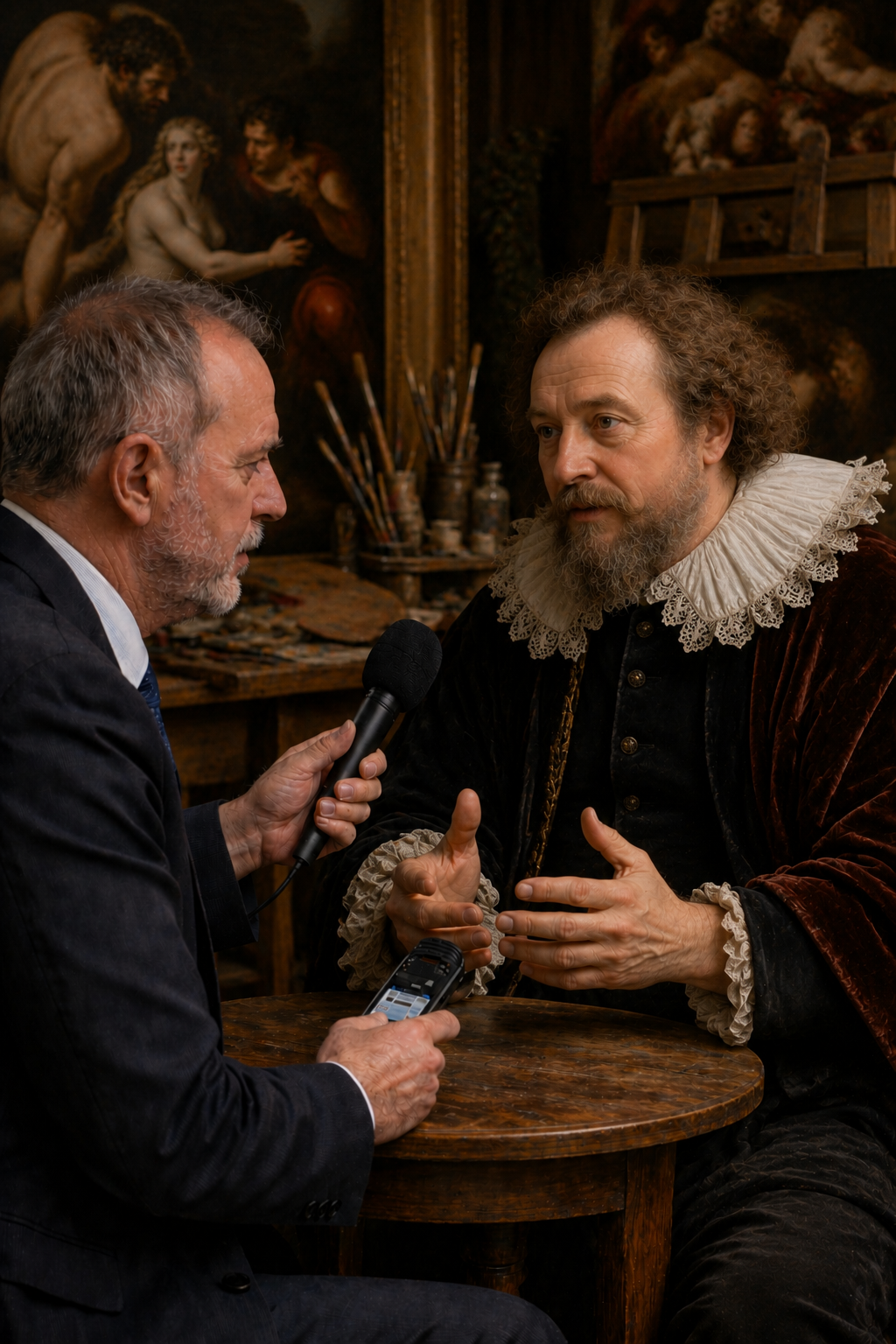
An ongoing series at stclaireart.com in which we imagine sitting down with the greatest artists in history.
First, I must say that Mr. Rubens arrived as if he owns the room — which, in a sense, he always did. Tall, well-dressed, at ease in a way that suggests a man who has dined with kings and enjoyed it. He looked around with genuine curiosity, took in the surroundings, and sat down without being invited. He was already smiling.
Me: You seem remarkably comfortable here for a man who has never seen the twenty-first century.
Rubens: I have been an ambassador. I have negotiated peace treaties between Spain and England. I have sat across tables from Philip IV and Charles I. (He gestures pleasantly at the room.) This is not so different. People are people. You want something from me, I want something from you. We will have a conversation and see where it goes.
Me: What do you want from me?
Rubens: (Leaning back, amused.) To be understood correctly for once.
Me: You were the most successful painter in Europe during your lifetime — wealthy, celebrated, knighted by two kings, running a studio with dozens of assistants. Did that ever feel like too much?
Rubens: Too much success? (He laughs warmly.) No. I will not pretend otherwise. I loved my work, I loved my life, I loved my home in Antwerp and my second home in the countryside. I loved my first wife and I loved my second wife. I loved the mornings in the studio when the light came in right and everything was going well. People seem to find this suspicious — as if a painter must suffer to be legitimate. I disagree entirely. Joy is not a lesser state than misery. It is harder to paint well, I think.
Me: Harder to paint joy than suffering?
Rubens: Much harder. Anyone can make you feel the weight of grief. To make you feel abundance, vitality, the sheer physical pleasure of being alive — that requires a different kind of skill. And more courage, frankly.
Me: Your figures are famous for their size, their flesh, their overwhelming physical presence. You painted bodies as celebrations. Was that a deliberate philosophy?
Rubens: It was a response to what I saw. The human body is extraordinary — its weight, its warmth, its capacity for movement and expression. I was not going to apologize for that or minimize it. When I painted a woman I painted a woman who existed fully in the world — who had weight and warmth and presence. The fashion now, I understand, is for something rather different.
Me: Rather different, yes.
Rubens: (Drily.) The world has always had opinions about how women should look. I ignored them then. I imagine I would ignore them now.
Me: What do critics and historians get most wrong about you?
Rubens: That I was merely prolific. As if the quantity of work somehow dilutes the quality. Yes, I ran a large studio. Yes, I had assistants who worked on backgrounds and drapery. This was normal — this was how it was done. But the hand that mattered was always mine, and anyone who looks carefully at the work knows exactly where I am in it and where I am not. Prolific is not the same as careless. I was never careless.
Me: Fair point. You also spoke six languages, served as a diplomat, and maintained one of the great libraries in Europe. Did painting ever feel like just one thing among many?
Rubens: Painting was always the center. Everything else orbited it. The diplomacy I did because it needed doing and I happened to be useful. The languages I learned because I was curious. The library because I could not stop reading. But every morning I went back to the studio. That was always where I lived most fully.
Me: If you had one day here — in this world, in 2026 — what would you do first?
Rubens: I want to see the museums. Not just my own work — I want to see everything that came after me. What did the French do in the nineteenth century? What happened after that? I have been told that painting went in directions. That would be surprising to see, I think.
Me: That might be an understatement.
Rubens: (With genuine delight.) Even better. I was never interested in the expected.
Me: Lastly, what would you say art is actually for?
Rubens: For celebrating existence. I know that is not a fashionable answer — suffering and struggle make better stories, I understand. But I painted life as I found it — abundant, complicated, sometimes violent, sometimes tender, always overwhelmingly present. Art at its best says: look at this. Look at how extraordinary it is to be here, in a body, in a world full of color and light and other people. That is not a small thing. That is, in fact, everything.
Peter Paul Rubens (1577–1640) was a Flemish Baroque painter, diplomat, and humanist scholar widely regarded as the greatest Northern European painter of his age. Fluent in six languages and knighted by both Philip IV of Spain and Charles I of England, he ran the most sought-after studio in Europe while simultaneously conducting diplomatic missions across the continent. His best known works include The Descent from the Cross, the Marie de' Medici cycle, and The Garden of Love.
This is an imagined interview. Rubens' responses are constructed from historical research, his surviving letters, contemporary accounts of his personality, and close study of his life and work. No direct quotes are presented as real.
No deceased artists were harmed in the making of this series.
Conversations Across Time: Caravaggio
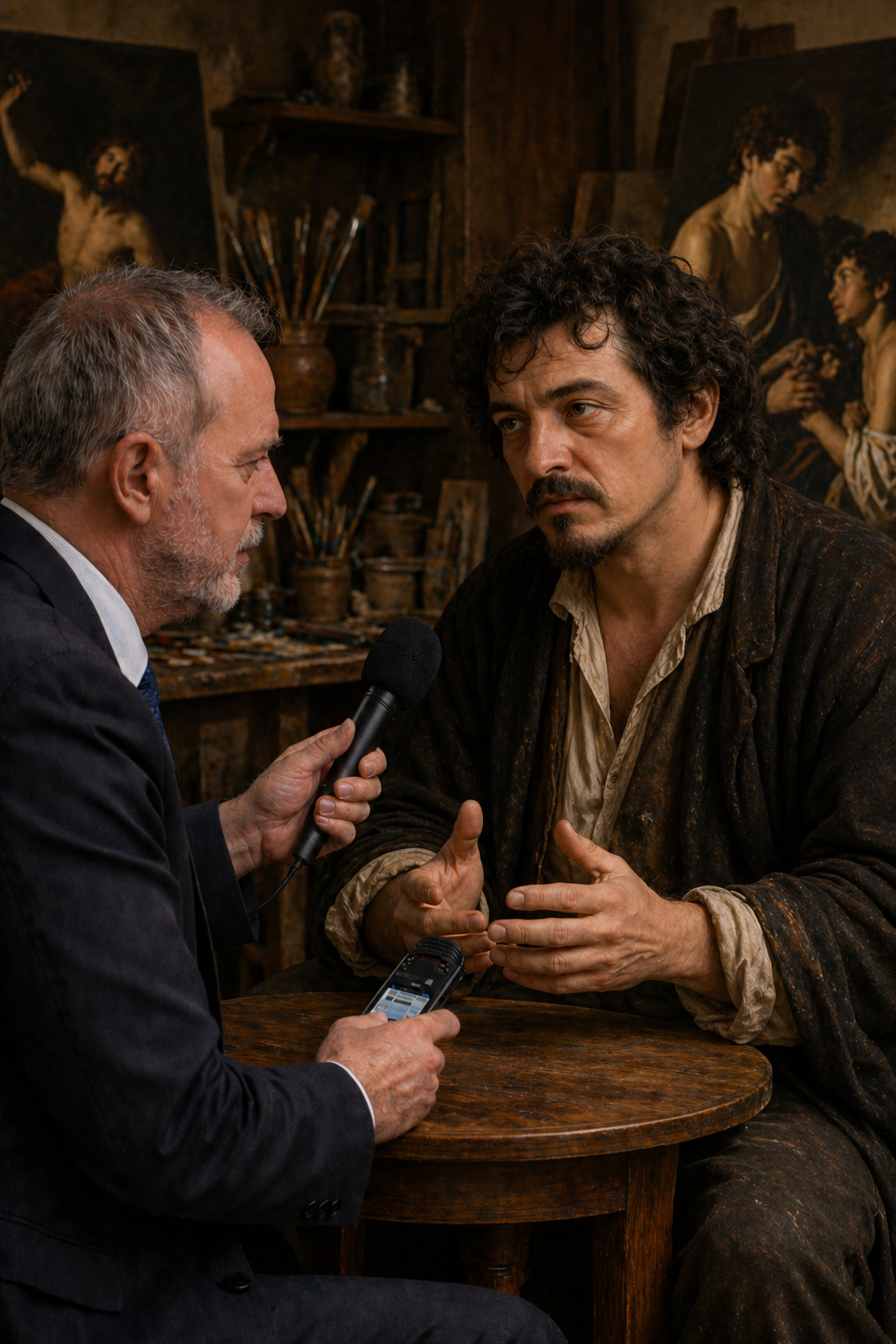
An ongoing series at stclaireart.com in which we imagine sitting down with the greatest artists in history.
This interview was interesting. This gentleman arrived looking like a man who has not slept well in years. He sat with his back to the wall, facing the door, and surveyed the room with the particular alertness of someone who has learned to be careful. It is 2026, though he does not seem entirely surprised to be here.
Me: I'll be honest — I wasn't sure you'd agree to this.
Caravaggio: (A short, hard laugh.) I have nothing but time at the moment. And I find I am tired of my own company. Ask your questions.
Me: You changed painting forever — the darkness, the light, the ordinary people pulled in from the streets to play saints and apostles. Where did that come from?
Caravaggio: From looking. From actually looking at the world rather than at other paintings. When I arrived in Rome every painter was painting other painters. Raphael painting Raphael painting Raphael. Beautiful, yes. True? No. I went into the streets. I found a prostitute and I painted her as the Virgin Mary. I found a peasant with dirty feet and I painted him as Saint Matthew. The Church was not always pleased.
Me: That's putting it mildly.
Caravaggio: (Drily.) They rejected the painting. Twice, in one case. But they always came back. Because people stood in front of those paintings and recognized something. They saw themselves. They saw their mothers, their neighbors, their own hands. That had not happened before, not like that. You cannot reject that forever, no matter how uncomfortable it makes you.
Me: The darkness in your work — the dramatic shadows, the figures emerging from almost pure black. Was that a technical choice or something more personal?
(A long pause. He looks at his hands.)
Caravaggio: Both. Always both. I understood very early that light means nothing without darkness. A face fully lit is a face with nowhere to hide. But catch it half in shadow and suddenly there is mystery — there is an interior life, something the viewer has to complete themselves. That is where the drama lives. In what you cannot quite see.
Me: Some people have suggested the darkness reflected your own psychology.
Caravaggio: Some people should paint their own pictures and leave mine alone. He paused. But they are not entirely wrong.
Me: You killed a man. In a brawl in Rome in 1606. You've been running ever since. Does it follow you into the work?
Caravaggio: Everything follows me into the work. That is both the gift and the punishment of being a painter. You cannot separate what you have lived from what you make. After Rome — after the killing — the paintings got darker. More desperate. More — I don't know the word. More aware of how quickly it can end. Look at the late work. Look at the David with the Head of Goliath. That is my own face on Goliath's severed head. I painted myself as the monster. As the defeated thing. Make of that what you will.
Me: That's an extraordinary act of self-examination.
Caravaggio: Or self-punishment. I have never been entirely sure which.
Me: What do think critics and historians get most wrong about you?
Caravaggio: They make the life the story and forget the work. Yes, I was violent. Yes, I fled Rome. Yes, I spent time in prison more than once. These things are true and I do not deny them. But I did not change the history of painting by being violent. I changed it by working. By getting up every morning — or every afternoon, I was never an early riser — and standing in front of a canvas and solving problems that no one had solved before. The life makes a good story. The work is the actual point.
Me: If you had one day in the present — our world, right now — what would you do first?
I want to see what became of the light. Photography, cinema — I have heard about these things. Capturing light on a surface, freezing a moment. (Something shifts in his face.) That is what I was trying to do. With paint, with a candle, in a dark room. I want to see if they understood what they were doing — if they knew they were continuing something that started in my studio in Rome.
Me: I think some of them knew exactly that.
Caravaggio: (Quietly, and with what might be satisfaction.) Good.
Me: And lastly, what would you say art is actually for?
Caravaggio: To show people what they are actually looking at. Not what they think they see — what is really there. A saint is a human being who was afraid and went forward anyway. A sinner is a human being who made a choice in a bad moment. I painted both with the same faces because they are the same people. Art strips away the comfortable story and shows you the truth underneath. That is not always a pleasant experience. It was never meant to be.
Michelangelo Merisi da Caravaggio (1571–1610) was an Italian painter whose revolutionary use of dramatic light and shadow — chiaroscuro — and his insistence on gritty, unidealized realism transformed Western painting and gave birth to the Baroque. Volatile, violent, and perpetually in trouble with the law, he spent the last years of his life in exile, dying under mysterious circumstances at thirty-eight, a papal pardon reportedly just days away. His best known works includeThe Calling of Saint Matthew, the Judith Beheading Holofernes, and David with the Head of Goliath.
This is an imagined interview. Caravaggio's responses are constructed from historical research, contemporary accounts of his personality and documented life events, and close study of his body of work. No direct quotes are presented as real.
No deceased artists were harmed in the making of this series.
Conversations Across Time: Raphael
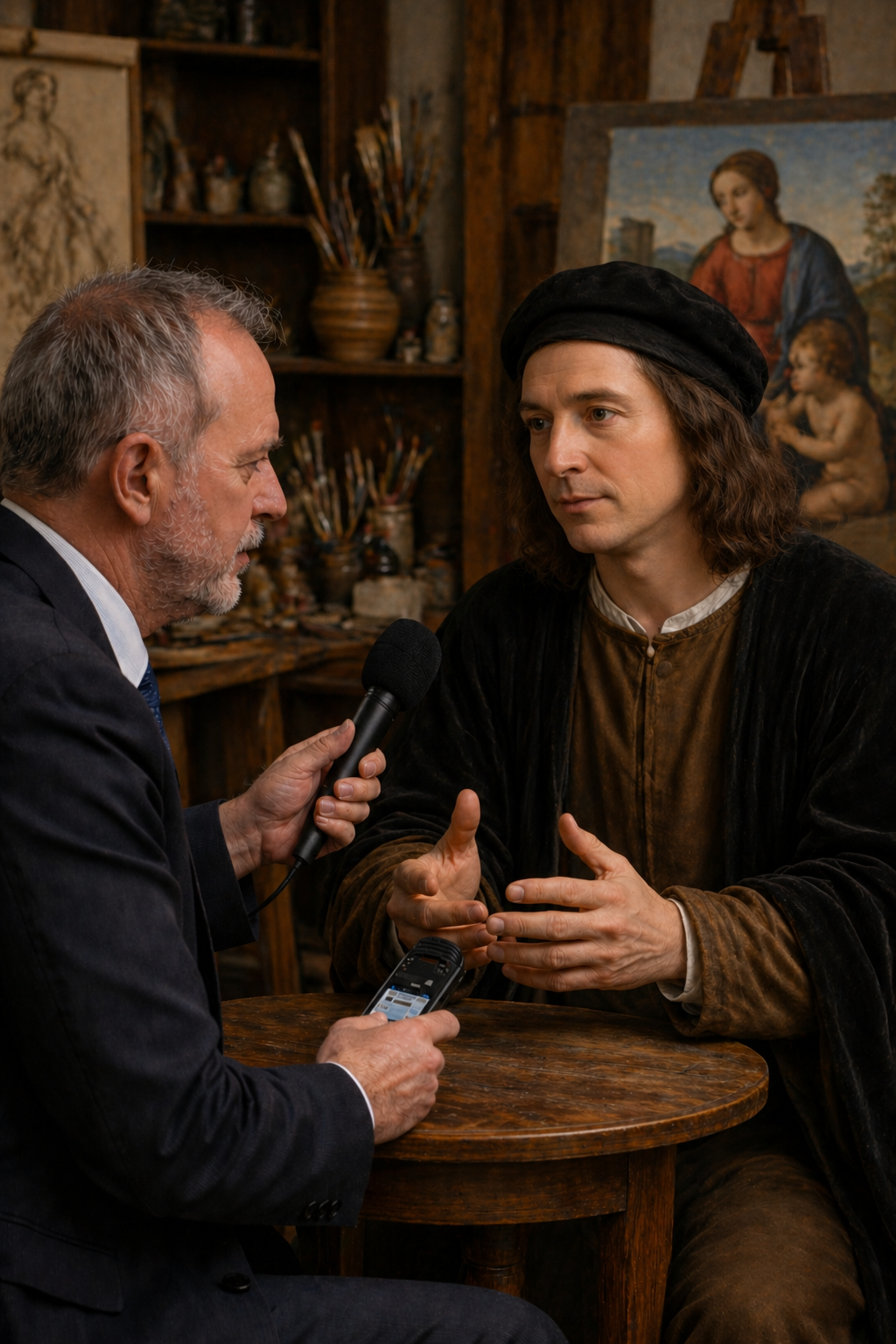
An ongoing series at stclaireart.com in which we imagine sitting down with the greatest artists in history.
When I set up this interview, I was invited to meet in Rome, in a studio that felt less like a workplace and more like a gathering place — assistants moving quietly in the background, light pouring through high windows. The master stood to greet me before I even sat down. He is younger looking than I expected.
Me: You're more relaxed than the last few people I've sat with in this series.
Raphael: (Laughing.) Who have you been talking to? Michelangelo?
Me: Among others.
Raphael: Then I am not surprised. Sit down. Can I offer you anything?
Me: You died at thirty-seven. In those thirty-seven years you produced a body of work that most artists couldn't match in a hundred. Did you have some sense that time was short?
Raphael: I had a sense that there was always more to do than time allowed. Whether I knew how little time I had — no. I don't think any of us knows that. But I worked quickly because I loved working. It was not anxiety that drove me. It was appetite. Every commission was a new problem, a new room, a new surface, a new set of ideas to wrestle with. I found that — I find that — I cannot think of anything I would rather be doing.
Me: Even now, knowing how it ends at thirty-seven?
Raphael: (A pause, something flickering across his face.) Even now. The work was the life. The life was the work. I have no complaints about what I was given.
Me: You were a student of Perugino, and then you came to Florence and encountered Leonardo and Michelangelo. That must have been like walking into a thunderstorm.
Raphael: That is exactly what it was. I arrived thinking I knew something — Perugino had taught me well, I was already receiving commissions — and then I saw what Leonardo was doing with shadow, what Michelangelo was doing with the human form, and I understood very quickly that I needed to start over.
Me: That kind of humility is rare, sir.
Raphael: It was not humility. It was clarity. There is no point in pretending you are further along than you are. I looked at the cartoon for the Battle of Anghiari and I thought — I cannot do that yet. So I learned how. A painter who cannot be changed by what he sees has stopped growing. I never wanted to stop growing.
Me: What do critics and historians get most wrong about you?
Raphael: That I was somehow easier than the others. Smoother. More decorative. As if grace and harmony are lesser achievements than struggle and torment. Michelangelo suffered visibly and so people decided his work must be deeper. I made it look effortless and so people decided it must have been. Neither is true, of course. The School of Athens alone — the architecture, the fifty-eight figures, each one a specific philosopher with a specific gesture and a specific relationship to every other figure in the room — that did not happen effortlessly. I simply did not see the point of making my difficulties your problem.
Me: That might be the most elegant thing anyone has said to me in this series.
Raphael: (Smiling.) I have had practice.
Me: You were enormously charming, socially gifted, beloved by popes and patrons alike. Was any of it an act?
Raphael: All of it and none of it. I genuinely liked people. I was genuinely interested in them. But I also understood very early that a painter who cannot get along with his patrons is a painter who does not work, and a painter who does not work is simply a person with ideas that go nowhere. The charm was real. The usefulness of the charm was also real. I saw no contradiction there.
Me: If you had one day in the present — our world, right now — what would you do first?
Raphael: I would go to the Vatican and stand in the Stanza della Segnatura and look at the School of Athens for as long as they would let me. I want to see it with modern eyes — with the distance of five hundred years. When you are inside the making of something you cannot see it whole. I never could. I want to finally see it whole.
Me: It is considered one of the greatest paintings ever made.
Raphael: (Quietly, and without vanity.) I know. I just want to see it for myself.
Me: And finally…What is art actually for?
Raphael: Interesting question. I think, art is for bringing people together around something larger than themselves. Look at the School of Athens — Plato and Aristotle at the center, every great mind of antiquity gathered in one imagined space, in conversation, in disagreement, in the shared pursuit of understanding. That is what art does at its best. It creates a room that everyone can enter. It says — here are the best things human beings have thought and felt and made. Come in. Sit down. You belong here too.
Raffaello Sanzio da Urbino (1483–1520), known as Raphael, was an Italian painter and architect of the High Renaissance whose work is celebrated for its clarity, grace, and visual achievement of the Neoplatonic ideal of human grandeur. Alongside Leonardo and Michelangelo he forms the triumvirate of the great masters of that period. He died in Rome on his 37th birthday, widely mourned. His best known works include The School of Athens and the Sistine Madonna.
This is an imagined interview. Raphael's responses are constructed from historical research, contemporary accounts of his personality and working methods, and close study of his life and work. No direct quotes are presented as real.
No deceased artists were harmed in the making of this series.
Conversations Across Time: Michelangelo
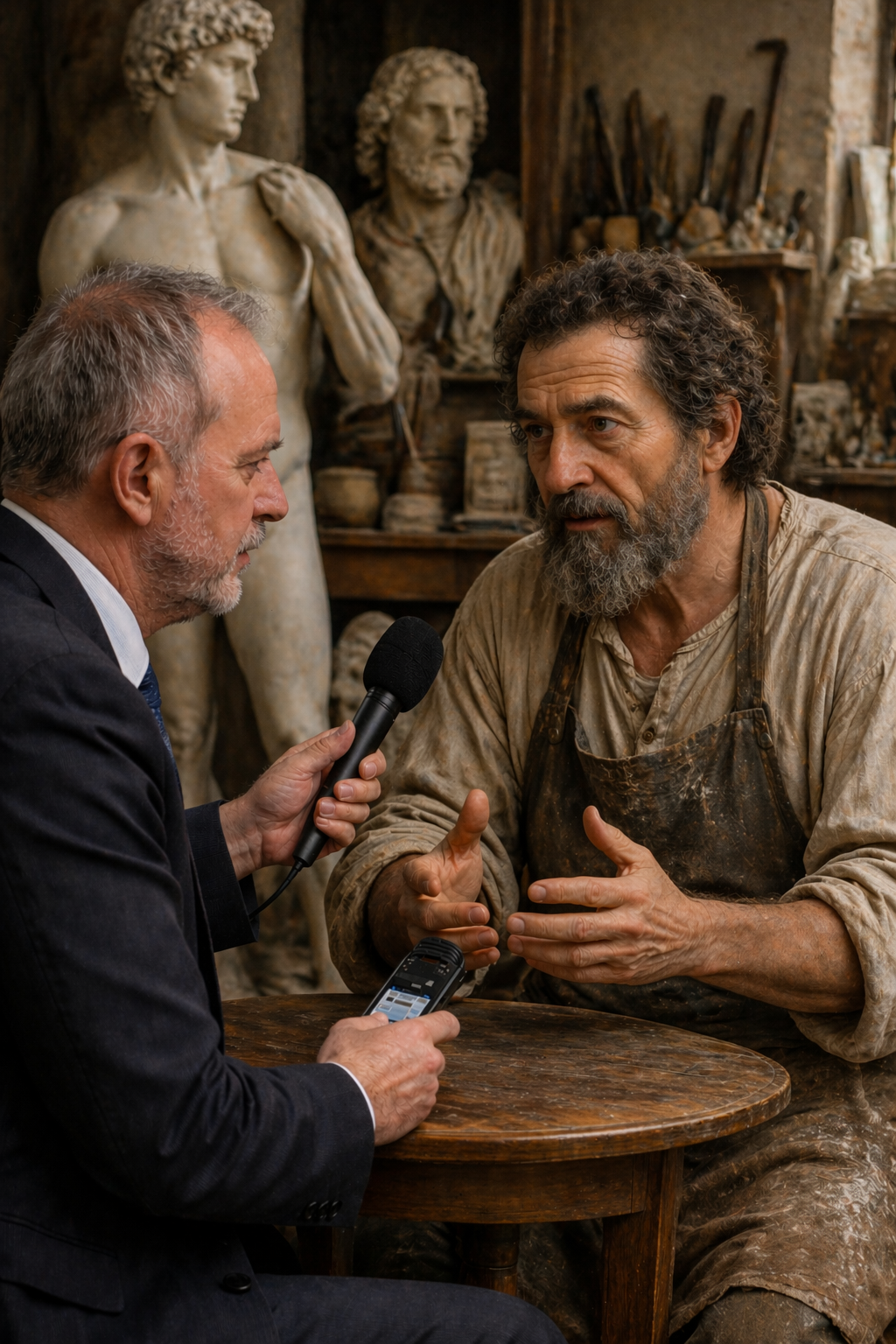
An ongoing series at stclaireart.com in which we imagine sitting down with the greatest artists in history.
Me: We're sitting in your studio in Rome. There is marble dust on everything, including you. You've been working this morning already.
Michelangelo: I am always working. Ask your questions.
Me: I will do that. First of all, you are perhaps the only artist in history who was called "divine" during his own lifetime. How did you carry that?
Michelangelo: Badly, I think. (He says this without humor.) It is a dangerous thing to be told you are divine when you are also a man who sleeps poorly and quarrels with his patrons and worries about money. The gap between what people believed I was and what I knew myself to be — that gap was not comfortable to live inside. I was not divine. I was someone who worked. I could not stop working even when it was killing me.
Me: And it nearly did, several times.
Michelangelo: The Sistine ceiling alone — four years on my back, the paint dripping into my eyes, my neck so damaged I could not hold my head straight for months afterward. Pope Julius would bang on the door and demand to know when it would be finished. I wanted to throw him from the scaffolding on more than one occasion.
Me: I'd have paid to see that.
Michelangelo: (The ghost of a smile.) So would I.
Me: You always insisted you were a sculptor first, not a painter. Yet the Sistine Chapel ceiling is arguably the most famous painted surface in the world. Does that irk you?
Michelangelo: Irk is too small a word. I was given a ceiling and told to paint apostles in the corners. Apostles in the corners! I looked at that ceiling and I saw — everything. The whole story of man and God and creation and failure and redemption. So I painted everything. And now people come from every corner of the earth to lie on their backs and look up and they do not know — they cannot know — what it cost.
Me: What did it cost?
Michelangelo: (A long pause.) I wrote a poem about it at the time. About my body twisted and ruined, paint falling on my face like a floor. I meant it as a complaint. People now read it as a testament. (Drily.) That seems about right.
Me: What do critics and historians get most wrong about you?
Michelangelo: They romanticize the suffering. They think the torment was the source of the genius — that I had to be miserable to make beautiful things. This is nonsense. I was miserable because the work was hard and the patrons were difficult and the marble was sometimes wrong and the human body refused to do what I asked of it. The suffering was not the point. The work was the point. I would have preferred to be happy and make the same things. I was simply not given that option.
Me: Were you ever happy?
Michelangelo: (He thinks about this with what seems like genuine effort.) There were moments inside the work. When something resolved — when a figure finally did what I had been trying to make it do for weeks — there was something in that. Not happiness exactly. Relief, perhaps. The relief of a problem solved.
Me: The Pietà — you made it when you were twenty-four years old. Twenty-four. How?
Michelangelo: I had been looking at it my whole life. Every pietà I had ever seen was wrong — the Virgin too old, too grief-stricken, the composition fighting itself. I knew what it should be before I touched the marble. Mary had to be young — ageless, really. Grief of that magnitude does not age a person. It suspends them. And Christ had to lie across her with the full weight of what had been lost — not the weight of a body, but the weight of the world. The marble told me the rest.
Me: "The marble told you." You've said that before — that the figure already exists inside the stone.
Michelangelo: It is not mysticism. It is attention. You look at the block long enough, you see where it wants to go. The sculptor's job is simply to remove what does not belong.
Me: If you had one day in the present — our world, right now — what would you do first?
Michelangelo: I would go to Disneyland. Hah! Just kidding. I would definitely go to the Accademia in Florence and stand before the David for as long as they would allow me. Not out of vanity — I want to see what time has done to him. Whether he still holds. Whether the tension in the shoulders reads the way I intended across five hundred years.
Me: He still stops people in their tracks.
Michelangelo: (Quietly, as if to himself.) Good. He should. He is about to do something terrifying and he knows it and he is going to do it anyway. That is the whole of it. That is what I put into the marble.
Me: What is art actually for?
To close the distance between the human and the divine. I do not mean this in a soft or decorative sense. I mean it literally. We are imperfect creatures living imperfect lives and we sense — we cannot help but sense — that there is something larger than us, something that does not decay the way we decay. Art is the attempt to touch that thing. To make something that participates in permanence even briefly. The Sistine ceiling will outlast everyone who has ever stood beneath it. That is not nothing. That is, in fact, almost everything.
Michelangelo di Lodovico Buonarroti Simoni (1475–1564) was a Florentine sculptor, painter, architect, and poet widely considered one of the greatest artists of all time. Fiercely devout, famously difficult, and relentlessly prolific, he worked into his eighties and left behind a body of work that remains without parallel. His best known works include the Pietà, theDavid, and the ceiling of the Sistine Chapel in Rome.
This is an imagined interview. Michelangelo's responses are constructed from historical research, his own surviving letters and poems, and contemporary accounts of his life and personality. No direct quotes are presented as real.
No deceased artists were harmed in the making of this series.
Conversations Across Time: Sandro Botticelli
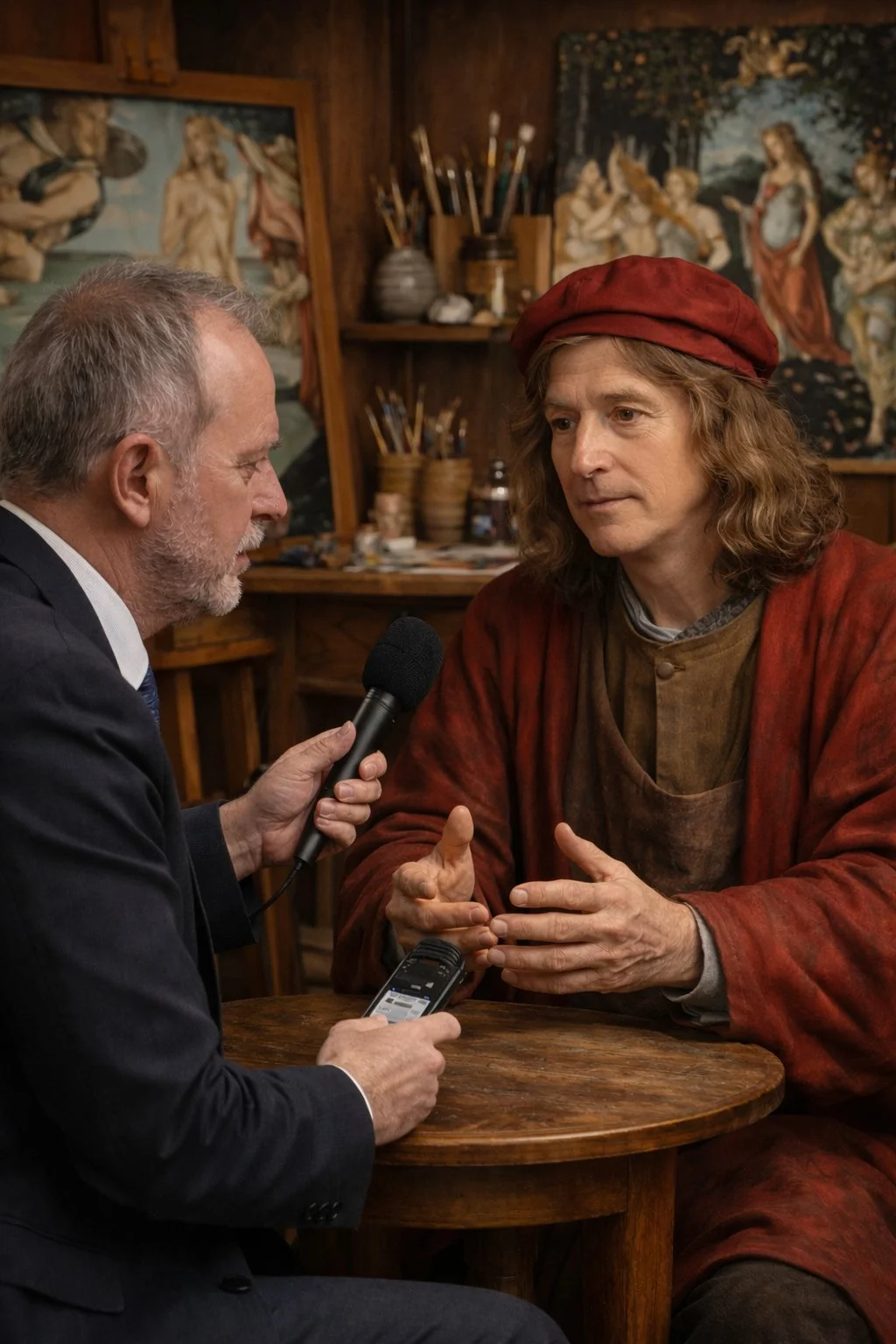
An ongoing series at stclaireart.com in which we imagine sitting down with the greatest artists in history.
Me: Master Botticelli, it is truly and honor to meet you. Thank you for your time. To begin with, I wanted to ask you about your painting “The Birth of Venus”. That piecewas considered scandalous when it was made — a life-sized goddess with nothing between her and the viewer but paint and air, the first such figure on that scale since antiquity.
Botticelli: Nervous is not quite the word. I was aware that I was doing something that had not been done for a very long time. But the Medici understood what I was trying to say. Lorenzo and his circle — they believed that beauty itself was a form of truth, that the ancient world had something to teach us about the divine that the Church had not entirely captured. Venus rising from the sea is not a pagan provocation. She is an idea. The arrival of beauty into the world. The soul descending into matter.
Me: That's a very philosophical defense of painting a gorgeous woman with nothing left to the imagination.
Botticelli: (Laughing softly.) Yes, well. Philosophy and beauty have always gotten along rather well.
Me: You were deeply connected to the Medici family and their circle of humanist philosophers. How much did that world shape what you painted?
Botticelli: Entirely. I cannot overstate it. Marsilio Ficino, Poliziano — these were men who spent their lives thinking about Plato, about the nature of love and beauty and the soul. I sat with them, listened to them, argued with them over dinner. When I painted Primavera — the three Graces, Mercury, Flora — I was painting their conversations. Their ideas given flesh and color and movement. Without the Medici I would have painted Madonnas for churches my whole life. They gave me permission to imagine a larger world.
Me: Do you think that was a gift or a complication?
Botticelli: (A pause.) Both. Always both.
Me: What would you say that critics and historians probably get most wrong about you?
Botticelli: They divide my life in two — the early Botticelli, full of beauty and mythology and light, and the later Botticelli, dark and religious and haunted. As if I became a different person. But I did not become a different person. The world became a different place. When Savonarola came, when Lorenzo died, when the bonfire of the vanities consumed so much of what we had made and loved — you could not simply continue painting spring goddesses as if none of that had happened. My later work is not a retreat. It is an honest response to loss.
Me: You reportedly burned some of your own paintings in Savonarola's bonfires.
Botticelli: (Quietly.) I was afraid. And I believed, for a time. I am not proud of the fear. The belief — that I understand better now, from a distance. But the fear I regret.
Me: The faces in your paintings — Venus, the Madonna, the Graces — they all share a certain quality. A kind of wistful melancholy even in moments of beauty. Was that deliberate?
Botticelli: I think beauty without some sadness in it is not entirely trustworthy. A face that is only happy is a face that has not yet understood what it means to be alive. The women I painted — they are beautiful, yes, but they are also aware of something. Some knowledge just at the edge of their expression. I could not paint innocence without also painting its fragility.
Me: Some people believe you were in love with Simonetta Vespucci — the woman thought to be the model for Venus. Were you?
Botticelli: (A long silence.) She was — there are some things a painter puts into his work precisely because he cannot put them anywhere else.
Me: That might be the most romantic answer I've ever received.
Botticelli: (Simply, without drama.) She died at twenty-three. I asked to be buried at her feet. Draw your own conclusions.
Me: If you had one day in the present — our world, right now — what would you do first?
Botticelli: I want to see what became of Florence. I know it is still there — I have heard it described. But I want to walk across the Ponte Vecchio and see if it still smells the same in the morning. I want to see whether the light on the Arno is as I remember it.
Me: I think you'd find it remarkably unchanged in some ways.
Botticelli: (Something in his face softens.) Good. Some things should be allowed to stay.
Me: And last question…What is art actually for?
Botticelli: I think the main goal of the artist is to make the invisible visible. Love, longing, the presence of the divine, the passing of time — none of these things have a shape you can point to. But a painting can give them a shape. When people stand before The Birth of Venus and feel something they cannot name — that nameless thing is the point. I was not painting a woman emerging from a shell. I was painting the moment beauty enters a life and changes it forever. If even one person has stood before that canvas and felt that — felt it in their body, not just understood it in their mind — then the painting has done what I asked of it.
Sandro Botticelli (1445–1510) was a Florentine painter of the early Renaissance, celebrated for his lyrical mythological works and his luminous Madonnas. A favorite of the Medici family, he moved in the most sophisticated intellectual circles of his age. In later life, under the influence of the fiery preacher Savonarola, he turned away from mythology toward intensely devotional religious work. His best known paintings include The Birth of Venus and Primavera.
This is an imagined interview. Botticelli's responses are constructed from historical research, contemporary accounts, and close study of his life and work. No direct quotes are presented as real.
No deceased artists were harmed in the making of this series.
Blog Archive
-
2026
- Aug 11, 2026 Conversations Across Time: Claude Monet Aug 11, 2026
- Jul 9, 2026 Parting Thoughts Jul 9, 2026
- Jul 4, 2026 Conversations Across Time: Johannes Vermeer Jul 4, 2026
- Jun 28, 2026 Conversations Across Time: Rembrandt van Rijn Jun 28, 2026
- Jun 26, 2026 Conversations Across Time: Diego Velázquez Jun 26, 2026
- Jun 8, 2026 Conversations Across Time: Peter Paul Rubens Jun 8, 2026
- Apr 29, 2026 Conversations Across Time: Caravaggio Apr 29, 2026
- Apr 26, 2026 Conversations Across Time: Raphael Apr 26, 2026
- Apr 21, 2026 Conversations Across Time: Michelangelo Apr 21, 2026
- Apr 16, 2026 Conversations Across Time: Sandro Botticelli Apr 16, 2026
- Apr 11, 2026 Conversations Across Time: Donatello Apr 11, 2026
- Apr 6, 2026 Conversations Across Time: Jan van Eyck Apr 6, 2026
- Apr 1, 2026 Conversations Across Time: Leonardo da Vinci Apr 1, 2026
- Mar 29, 2026 A Closing Reflection: Nine Ways Beauty Finds Us Mar 29, 2026
- Mar 27, 2026 Type Nine: The Recognition of Wholeness Mar 27, 2026
- Mar 24, 2026 Type Eight: The Encounter with Unfiltered Reality Mar 24, 2026
- Mar 18, 2026 Type Seven: The Pursuit of Radiant Possibility Mar 18, 2026
- Mar 16, 2026 Type Six: Beauty as Trust, Stability, and the Restoration of Ground Mar 16, 2026
- Mar 11, 2026 Type Five: Beauty as Insight and Essential Understanding Mar 11, 2026
- Mar 8, 2026 Type Four: Beauty as Identity and Emotional Truth Mar 8, 2026
- Mar 5, 2026 Type Three: Beauty as Significance and Radiance Mar 5, 2026
- Mar 1, 2026 Type Two: Beauty as Loving Connection Mar 1, 2026
- Feb 26, 2026 Type One: The Pursuit of Perfected Beauty Feb 26, 2026
- Feb 22, 2026 Why Personality Shapes the Way We Create and Experience Art Feb 22, 2026
- Feb 11, 2026 My Most Ambitious Project to Date: Pont Neuf at Dusk Feb 11, 2026
- Feb 8, 2026 The Human Rhythm: Why the Golden Section Matters Feb 8, 2026
- Jan 31, 2026 Nature’s Quiet Mathematics: The Golden Section at Work Jan 31, 2026
- Jan 24, 2026 The Golden Section in Architecture: Building with Human Scale Jan 24, 2026
- Jan 16, 2026 The Golden Section in Music: Proportions You Can Feel Jan 16, 2026
- Jan 14, 2026 The Golden Ratio in Art: Where Math Meets Beauty Jan 14, 2026
-
2025
- Dec 25, 2025 Finding Peace in the Christmas Chaos Dec 25, 2025
- Dec 14, 2025 Seeing Meaning: How Medieval Art Spoke Without Words Dec 14, 2025
- Nov 19, 2025 The Matterhorn and the Magic of Transformation Nov 19, 2025
- Nov 13, 2025 Commissions vs Completed Pieces…Which is Right for You? Nov 13, 2025
- Oct 28, 2025 What can I learn from Makoto Fujimura in 2025? Oct 28, 2025
- Oct 12, 2025 What can I learn from Pablo Picasso in 2025? Oct 12, 2025
- Oct 10, 2025 What can I learn from Raphael in 2025? Oct 10, 2025
- Oct 8, 2025 What can I learn from Georgia O’Keefe in 2025? Oct 8, 2025
- Sep 28, 2025 What can I learn from Caravaggio in 2025? Sep 28, 2025
- Jul 25, 2025 What can I learn from Thomas Gainsborough in 2025? Jul 25, 2025
- Jul 20, 2025 What can I learn from Leonardo da Vinci in 2025? Jul 20, 2025
- Jul 15, 2025 What can I learn from Michelangelo in 2025? Jul 15, 2025
- Jul 2, 2025 What can I learn from Van Gogh in 2025? Jul 2, 2025
- Jun 25, 2025 What can I learn from Renoir in 2025? Jun 25, 2025
- Jun 23, 2025 What can I learn from Claude Monet in 2025? Jun 23, 2025
- Jun 21, 2025 Using Complimentary Colors for Shading Jun 21, 2025
- Jun 17, 2025 How and When to use Complimentary Colors Jun 17, 2025
- May 30, 2025 Perspective in Art 101: How to Make Your Drawings Pop Off the Page May 30, 2025
- May 26, 2025 How to Really Understand Medieval Art May 26, 2025
- May 22, 2025 Staying Creative May 22, 2025
- May 10, 2025 AT Experience May 10, 2025
- May 3, 2025 Go Take a Walk! May 3, 2025
- Apr 25, 2025 Periods of Art: Mannerism Apr 25, 2025
- Apr 17, 2025 Finding Meaning in the Abstract: Pointers for Understanding Modern Art Apr 17, 2025
- Apr 16, 2025 The Quiet Labor Apr 16, 2025
- Apr 12, 2025 To Art: a Poem Apr 12, 2025
- Apr 5, 2025 The Enchantment of Art Nouveau Apr 5, 2025
- Mar 23, 2025 "What was it like going to art school?" Mar 23, 2025
- Mar 18, 2025 Why I Love the Rococo Period Mar 18, 2025
- Mar 4, 2025 Expressing Joy Through Art Mar 4, 2025
- Feb 28, 2025 The Connection Between Art and Frustration Feb 28, 2025
- Feb 23, 2025 Neoclassicism: Bringing Ancient Style Back to Life Feb 23, 2025
- Feb 18, 2025 On my walk Feb 18, 2025
- Feb 12, 2025 Art at the Very Beginning Feb 12, 2025
- Feb 10, 2025 Monet and Renoir: A Personal Reflection on Their Differences Feb 10, 2025
- Feb 6, 2025 The Fount of Creation: A poem Feb 6, 2025
- Feb 1, 2025 The Connection Between Art and Grief Feb 1, 2025
- Jan 29, 2025 A Journey Through Medieval Art: Stories from the Middle Ages Jan 29, 2025
- Jan 26, 2025 The Story of Art: The Romantic Period Jan 26, 2025
- Jan 16, 2025 The Relationship Between Music and Painting Jan 16, 2025
- Jan 12, 2025 Periods of Art: Baroque Jan 12, 2025
- Jan 11, 2025 Marketing your Artwork Jan 11, 2025
- Jan 7, 2025 Exploring the Golden Ratio in Art Jan 7, 2025
- Jan 3, 2025 Artistic Enlightenment: Lessons from Italy Jan 3, 2025
-
2024
- Dec 29, 2024 Why Travel is Crucial for Unleashing Creativity Dec 29, 2024
- Dec 22, 2024 Steps to Becoming a Full-Time Professional Artist Dec 22, 2024
- Dec 10, 2024 How to Determine Subject Matter for Your Next Painting Dec 10, 2024
- Dec 3, 2024 My Favorite Artist Dec 3, 2024
- Dec 1, 2024 Creativity and Exploration Dec 1, 2024
- Nov 13, 2024 Impressionistic Heroes of Mine Nov 13, 2024
- Nov 10, 2024 "So how do you DO this?" Nov 10, 2024
- Nov 3, 2024 Discovering the Bond Between Nature and Art Nov 3, 2024
- Nov 1, 2024 How Art Can Help Us Cope with Stress Nov 1, 2024
- Oct 27, 2024 How to Select the Perfect Art for Your Home Oct 27, 2024
- Oct 24, 2024 What to Do When You Feel Like Giving Up as an Artist Oct 24, 2024
- Oct 14, 2024 Book Review: The Artist’s Way Oct 14, 2024
- Oct 11, 2024 How to find Inspiration for your art Oct 11, 2024
- Sep 24, 2024 Crafting the Perfect Title for Your Artwork Sep 24, 2024
- Sep 14, 2024 The Worst Advice I’ve Ever Received as an Artist Sep 14, 2024
- Sep 8, 2024 Overcoming Artist’s Block: Practical Tips Sep 8, 2024
- Aug 30, 2024 Exploring Lessons from Vincent van Gogh Aug 30, 2024
- Aug 29, 2024 Why Purchase Original Artwork? Aug 29, 2024
- Aug 25, 2024 How do you determine the best size artwork to purchase? Aug 25, 2024
- Aug 15, 2024 "So, what's this painting worth?" Aug 15, 2024
- Aug 9, 2024 What color art would go best in my home? Aug 9, 2024
- Aug 4, 2024 How to deal with criticism as an artist Aug 4, 2024
- Mar 27, 2024 Question 12: "What do you do when you have a mental block?" Mar 27, 2024
- Mar 27, 2024 New Goals + Winter Months = "Outside the Box" Creativity Mar 27, 2024
- Jan 8, 2024 Question 11: Where do you get inspiration for your work? Jan 8, 2024
-
2023
- Sep 11, 2023 Question 10: "Do you have your work in galleries?" Sep 11, 2023
- Aug 27, 2023 Question 9: "How do you manage the business side of your art business?" Aug 27, 2023
- Aug 20, 2023 Question 8: "Do you advertise?" Aug 20, 2023
- Aug 13, 2023 Question 7: "How do you price your work?" Aug 13, 2023
- Jul 30, 2023 Question 6: "What are the positive points and negative points about having an 'open studio'?" Jul 30, 2023
- Jul 19, 2023 Question 5: "Would you mind critiquing my work at some point?" Jul 19, 2023
- Jul 1, 2023 Question 4: "Would you recommend art school, and if so, how would you find the right one?" Jul 1, 2023
- Jun 24, 2023 Question 3: "Did you go to art school? If so, where?" Jun 24, 2023
- Jun 16, 2023 Question 2: "How long have you been selling your work professionally?" Jun 16, 2023
- Jun 10, 2023 Question 1..."How long have you been an artist?" Jun 10, 2023
- Jun 4, 2023 So, you're thinking about art as a career? Jun 4, 2023
- Mar 3, 2023 "What inspires you as an artist?" Mar 3, 2023
- Feb 15, 2023 Should I buy a completed painting OR commission a painting? Feb 15, 2023
- Jan 23, 2023 "How do you Price Your Work?" Jan 23, 2023
-
2022
- Dec 1, 2022 An Artist in Italy (Part 3) Dec 1, 2022
- Nov 16, 2022 An Artist in Italy (Part 2) Nov 16, 2022
- Nov 8, 2022 An Artist in Italy (Part 1) Nov 8, 2022
- Oct 10, 2022 When Remodeling a Home... Oct 10, 2022
- Aug 22, 2022 How to Handle Failure Aug 22, 2022
- Jun 3, 2022 "What is it like being an artist these days?" Jun 3, 2022
- May 21, 2022 "Are All Artists Introverts?" May 21, 2022
- May 9, 2022 What Makes a Painting a Good Piece of Art? May 9, 2022
- Apr 1, 2022 The Story Behind…"Gentle Showers on a Summer Afternoon" Apr 1, 2022
- Mar 19, 2022 The Story Behind..."Blue Ridge Summer Afternoon" Mar 19, 2022
- Feb 18, 2022 Your Opinion Please... Feb 18, 2022
- Jan 22, 2022 What's in a Compliment? Jan 22, 2022
-
2021
- Dec 25, 2021 My Christmas Present to Joy Dec 25, 2021
- Dec 12, 2021 Deep in the Heart Dec 12, 2021
- Nov 29, 2021 "How do you know you're done with a painting?" Nov 29, 2021
- Nov 1, 2021 Does it Matter What Other People Think of My Art? Nov 1, 2021
- Oct 12, 2021 Creatively Inhaling... Oct 12, 2021
- Aug 31, 2021 More Fun than I Know What to do With Aug 31, 2021
- Aug 13, 2021 “Are You Self Taught?” Aug 13, 2021
- Jul 21, 2021 New Art Gallery on the West Coast Jul 21, 2021
- Jun 23, 2021 "Art from the Heart" vs "Commissioned Art" Jun 23, 2021
- May 28, 2021 More Questions and Answers May 28, 2021
- May 17, 2021 What does Diversity have to do with honest artwork? May 17, 2021
- May 4, 2021 More Questions and Answers May 4, 2021
- Apr 30, 2021 Questions and Answers Apr 30, 2021
- Apr 16, 2021 And the Next Blog Post is... Apr 16, 2021
- Mar 10, 2021 How do you create when you don't feel like creating? Mar 10, 2021
- Feb 11, 2021 "Mullaghmore": The Story Behind the Painting Feb 11, 2021
- Jan 28, 2021 A Look Back to "The Dark Year" Jan 28, 2021
- Jan 17, 2021 Studio Expansion...Hello Northeast! Jan 17, 2021
- Jan 7, 2021 How to Create the Perfect Painting Jan 7, 2021
-
2020
- Dec 1, 2020 A personal answer to a personal question... Dec 1, 2020
- Nov 4, 2020 Using Art to Express my Politics Nov 4, 2020
- Oct 16, 2020 Sometimes, just "having fun" is a good enough reason Oct 16, 2020
- Oct 4, 2020 The Best Painting Delivery Ever... Oct 4, 2020
- Sep 7, 2020 How a Dinky Little Virus Changed my Art Business Sep 7, 2020
- Aug 9, 2020 Adaptation: Survival of the Most Flexible Aug 9, 2020
- Aug 3, 2020 Story Behind the Painting: "Sundown over the Blue Ridge" Aug 3, 2020
- Jul 18, 2020 Cure for Covid blues Jul 18, 2020
- Jul 5, 2020 Where Does it Take You? Jul 5, 2020
- Jun 3, 2020 Story Behind the Painting: Autumn Day on the French Broad River Jun 3, 2020
- May 24, 2020 Story Behind the Painting: Saint-Jean-Cap-Ferrat May 24, 2020
- Apr 30, 2020 Q&A: SESSION TWO Apr 30, 2020
- Apr 22, 2020 Q&A: SESSION ONE Apr 22, 2020
- Apr 8, 2020 What I'll Miss When This Pandemic is Over... Apr 8, 2020
- Mar 20, 2020 Entertaining Angels Unawares Mar 20, 2020
- Mar 8, 2020 In Celebration of Art Mar 8, 2020
- Feb 27, 2020 "The Bridge" Feb 27, 2020
- Feb 8, 2020 The Most Interesting Question of the Year (but it's only February so...) Feb 8, 2020
- Jan 29, 2020 "Can I Watch You?" Jan 29, 2020
- Jan 14, 2020 From Point A to Point Z Jan 14, 2020
- Jan 5, 2020 An Impractical Idea Jan 5, 2020
-
2019
- Dec 17, 2019 My Beautiful Baby on Display Dec 17, 2019
- Dec 3, 2019 Regarding the Selection of an Artistic Theme Dec 3, 2019
- Nov 20, 2019 "What's Your Best Price on This Piece?" Nov 20, 2019
- Nov 13, 2019 A Really Unique Commission Project Nov 13, 2019
- Nov 6, 2019 Fun with Art Scammers Nov 6, 2019
- Nov 3, 2019 "How did you know you wanted to be an artist?" Nov 3, 2019
- Oct 30, 2019 How do you know when a painting is "done"? Oct 30, 2019
- Oct 20, 2019 The piece I had to paint: "Côte d’Azur" Oct 20, 2019
- Oct 18, 2019 Inspiration Everywhere! Oct 18, 2019
- Aug 26, 2019 Contentment vs Restlessness Aug 26, 2019
- Aug 14, 2019 "Why Should I Purchase Artwork?" Aug 14, 2019
- Aug 11, 2019 What Was Art School Like? Aug 11, 2019
- Aug 7, 2019 "The Four Seasons on the French Broad River" Aug 7, 2019
- Jul 30, 2019 Joy Unspeakable Jul 30, 2019
- Jul 7, 2019 Of Mountains and Oceans Jul 7, 2019
- Jul 3, 2019 Lessons I've Learned as an Artist Jul 3, 2019
- Jun 26, 2019 St.Claire Art Opening at the AC Hotel, Asheville Jun 26, 2019
- Jun 23, 2019 "How do you decide what to paint?" Jun 23, 2019
- Jun 5, 2019 One of my All-Time Heroes Jun 5, 2019
- Jun 2, 2019 Regarding "Inspiration" vs "Necessity" Jun 2, 2019
- May 29, 2019 The Best Complement I've Ever Received May 29, 2019
- May 19, 2019 "What are you Working on These Days?" May 19, 2019
- May 5, 2019 "Frankenstein-ing" a painting May 5, 2019
- Apr 17, 2019 The Big Reveal Apr 17, 2019
- Apr 3, 2019 "How do you Decide What to Paint?" Apr 3, 2019
- Mar 27, 2019 "I'm just not making the sales I need!" Mar 27, 2019
- Mar 20, 2019 Making the Most of Mistakes Mar 20, 2019
- Mar 10, 2019 Exploring Austin Galleries, Part 2 Mar 10, 2019
- Feb 25, 2019 Exploring Austin Galleries, Part 1 Feb 25, 2019
- Feb 10, 2019 Progress! Feb 10, 2019
- Jan 23, 2019 Preliminary Photos of my "Sails" Prototypes Jan 23, 2019
- Jan 16, 2019 The Benefits of Slowing Down Jan 16, 2019
- Jan 8, 2019 New Idea Taking Shape Jan 8, 2019
-
2018
- Dec 29, 2018 Looking Back and Looking Ahead Dec 29, 2018
- Dec 19, 2018 Percolating Creativity Dec 19, 2018
- Dec 16, 2018 So then... Dec 16, 2018
- Dec 12, 2018 What if... Dec 12, 2018
- Dec 5, 2018 Recent Projects on my Plate Dec 5, 2018
- Dec 3, 2018 Claude: My Creative Hero and Muse Dec 3, 2018
- Nov 22, 2018 Lessons I've Learned as an Artist Nov 22, 2018
- Nov 12, 2018 Planning for a Second Studio Location! Nov 12, 2018
- Nov 7, 2018 Steps Involved with a Painting Commission Nov 7, 2018
- Nov 4, 2018 How do you stay "balanced"? Nov 4, 2018
- Oct 28, 2018 What makes art "Art"? Oct 28, 2018
- Oct 21, 2018 "How Did You Stumble Across This Type of Artwork?" Oct 21, 2018
- Oct 17, 2018 "A Personal History" Oct 17, 2018
- Oct 14, 2018 Commission Confusion Oct 14, 2018
- Oct 10, 2018 "Aqueous Dream" Oct 10, 2018
- Oct 7, 2018 Beauty in the Center of the Pit Oct 7, 2018
- Sep 30, 2018 Only North Carolina? Sep 30, 2018
- Sep 23, 2018 The Price of Being a Landscape Painter Sep 23, 2018
- Sep 9, 2018 Thoughts on New Directions, New Possibilities Sep 9, 2018
- Aug 29, 2018 SURVEY: GLOSSY OR SATIN Aug 29, 2018
- Aug 22, 2018 Regarding Commissioning a Painting Aug 22, 2018
- Aug 19, 2018 On the Brink of a Huge Failure Aug 19, 2018
- Aug 7, 2018 "The Trail That Never Ends" Aug 7, 2018
- Aug 5, 2018 Inspration Begets Inspiration Aug 5, 2018
- Jul 19, 2018 Rejuvenating Creativity! Jul 19, 2018
- Jul 15, 2018 A Word About Accolades Jul 15, 2018
- Jul 10, 2018 Where it Began Jul 10, 2018
- Jul 4, 2018 Funny Things People Say in an Art Studio Jul 4, 2018
- Jun 29, 2018 "The Time Between Times" Jun 29, 2018
- Jun 27, 2018 World View #8: Post Modernism Jun 27, 2018
- Jun 21, 2018 World View #7: New Age Pantheism Jun 21, 2018
- Jun 12, 2018 A New Opportunity -- A New Idea Jun 12, 2018
- Jun 6, 2018 The Art of Dinner (at the Grove Park Inn) Jun 6, 2018
- Jun 3, 2018 National Geographic?!? Jun 3, 2018
- Jun 1, 2018 World View #6: Modernism Jun 1, 2018
- May 24, 2018 The Art of Dinner (with the Dallas Cowboys) May 24, 2018
- May 13, 2018 Carving Mountains from Scratch May 13, 2018
- May 10, 2018 "Trigger Warning" May 10, 2018
- May 7, 2018 World View #5: Existentialism May 7, 2018
- Apr 29, 2018 World View #4: Nihilism Apr 29, 2018
- Apr 11, 2018 World View #3: Naturalism Apr 11, 2018
- Apr 4, 2018 World View #2: Deism Apr 4, 2018
- Mar 26, 2018 World View #1: Theism Mar 26, 2018
- Mar 23, 2018 A Time to be Disturbed Mar 23, 2018
- Mar 14, 2018 Understanding Art 101 Mar 14, 2018
- Mar 8, 2018 The Organ Mountains Mar 8, 2018
- Mar 7, 2018 "Remember...there are no mistakes with art" Mar 7, 2018
- Mar 2, 2018 The Biltmore Estate Mar 2, 2018
- Feb 21, 2018 How to Make a Living as an Artist (Part 2) Feb 21, 2018
- Feb 12, 2018 How to Make a Living as an Artist Feb 12, 2018
- Feb 4, 2018 How do you create when you don't feel creative? Feb 4, 2018
- Jan 24, 2018 Gallery Representation in Hendersonville! Jan 24, 2018
- Jan 19, 2018 Metalizing the Biltmore Estate Jan 19, 2018
- Jan 15, 2018 Four Seasons on the Blue Ridge Jan 15, 2018
- Jan 11, 2018 About Ice... Jan 11, 2018
- Jan 10, 2018 What's Next? Jan 10, 2018
-
2017
- Dec 20, 2017 Mountain Top Experiences Dec 20, 2017
- Dec 18, 2017 The Power of Mystery Dec 18, 2017
- Dec 7, 2017 Forsyth Park Fountain Dec 7, 2017
- Dec 6, 2017 Angsty or Terrified? Dec 6, 2017
- Dec 4, 2017 To the "Angsty" Artist... Dec 4, 2017
- Dec 3, 2017 "I woudn't pay HALF of what he's asking!" Dec 3, 2017
- Nov 20, 2017 "On the Water" Nov 20, 2017
- Nov 19, 2017 Song of Autumn Nov 19, 2017
- Nov 15, 2017 "Top of the Mountain" Nov 15, 2017
- Nov 5, 2017 "How do you decide what to paint?" Nov 5, 2017
- Nov 2, 2017 "Valley of Shadows" Nov 2, 2017
- Nov 1, 2017 Forest of Autumn Gold Nov 1, 2017
- Oct 25, 2017 Then and Now Oct 25, 2017
- Oct 24, 2017 Catawba Falls Oct 24, 2017
- Oct 18, 2017 "Valley of Shadows" Oct 18, 2017
- Oct 11, 2017 Autumn River Song Oct 11, 2017
- Oct 3, 2017 Autumnal Shift Oct 3, 2017
- Sep 28, 2017 Mystic Summer Morning Sep 28, 2017
- Sep 24, 2017 Valley of Shadows Sep 24, 2017
- Sep 1, 2017 the breakers Sep 1, 2017
- Aug 24, 2017 When the Sun Went Dark Aug 24, 2017
- Aug 17, 2017 Secret Blog Post Aug 17, 2017
- Aug 14, 2017 Waterfalls Everywhere! Aug 14, 2017
- Aug 11, 2017 "Cullasaja Falls" Completion photo Aug 11, 2017
- Aug 8, 2017 Finishing up "My Marathon" Aug 8, 2017
- Aug 1, 2017 One of the Best Days Ever! Aug 1, 2017
- Jul 26, 2017 "Glacial Fractures in situ" Jul 26, 2017
- Jul 24, 2017 Inspiration and Rest Jul 24, 2017
- Jul 18, 2017 Half Baked Ideas... Jul 18, 2017
- Jul 13, 2017 Oaks on the Water Jul 13, 2017
- Jul 9, 2017 Challenged to the Core Jul 9, 2017
- Jul 5, 2017 Boats on the Water Jul 5, 2017
- Jun 30, 2017 Glacial Fractures Jun 30, 2017
- Jun 29, 2017 Winter in the Summer! Jun 29, 2017
- Jun 27, 2017 What's in a Compliment? Jun 27, 2017
- Jun 23, 2017 Thoughts on a Mighty Failure Jun 23, 2017
- Jun 20, 2017 Sunrise on the Mountain Jun 20, 2017
- Jun 14, 2017 The Last Sunset (is that dramatic or what?) Jun 14, 2017
- Jun 12, 2017 Sunset or Sunrise? End or Beginning? Jun 12, 2017
- Jun 9, 2017 At the End of the Day Jun 9, 2017
- Jun 8, 2017 Giverny: My Homage to the Man Jun 8, 2017
- Jun 2, 2017 A Funny Thing Happened at the Studio Today... Jun 2, 2017
- Jun 2, 2017 Sunrise, Sunset... Jun 2, 2017
- May 29, 2017 Color Explosion May 29, 2017
- May 22, 2017 My Largest Painting to Date... May 22, 2017
- May 18, 2017 What to do with 2000 visitors in an art studio... May 18, 2017
- May 9, 2017 My Creative Muse May 9, 2017
- May 3, 2017 Joys of Life May 3, 2017
- Apr 28, 2017 Regarding Art & Beauty Apr 28, 2017
- Apr 25, 2017 Getting Better Acquainted Apr 25, 2017
- Apr 23, 2017 Rainy Sunday Morning Thoughts Apr 23, 2017
- Apr 22, 2017 Personal Thoughts Apr 22, 2017
- Apr 19, 2017 Favorite Hikes (Inspiration in the Making)... Apr 19, 2017
- Apr 15, 2017 Inspiration is Everywhere (some of our favorite hiking trails) Apr 15, 2017
- Apr 9, 2017 "Where should we eat tonight?" Apr 9, 2017
- Apr 6, 2017 Who Else Should We See in the District? Apr 6, 2017
- Apr 1, 2017 Spring in Western North Carolina Apr 1, 2017
- Mar 29, 2017 "Can you really make a living here?" Mar 29, 2017
- Mar 25, 2017 Of Ruination and Rescue Mar 25, 2017
- Mar 21, 2017 How I decide what to paint... Mar 21, 2017
- Mar 18, 2017 Musings of an artist... Mar 18, 2017
- Mar 14, 2017 Winter thoughts Mar 14, 2017
- Mar 13, 2017 "What makes this painting so sparkly?" Mar 13, 2017
- Mar 10, 2017 You're From Where? Mar 10, 2017
- Mar 5, 2017 "No Boundaries" Mar 5, 2017
- Mar 3, 2017 Appalachian Trail Mar 3, 2017
- Mar 2, 2017 What is 'good' art? Mar 2, 2017
- Feb 26, 2017 A Trip to the Art Museum Feb 26, 2017
- Feb 23, 2017 "The Rules" of Art Feb 23, 2017
- Feb 15, 2017 To School or Not to School... Feb 15, 2017
- Feb 10, 2017 How Do I Start This Thing? Feb 10, 2017
- Feb 9, 2017 Rocky Mountains reflection Feb 9, 2017
- Feb 7, 2017 Getting Inspired Feb 7, 2017
- Feb 5, 2017 Inspiration for a painting... Feb 5, 2017
- Jan 31, 2017 Understanding Abstract Art Jan 31, 2017
- Jan 29, 2017 Chi Jan 29, 2017
- Jan 26, 2017 Process: Rocky Mountain Commission Jan 26, 2017
- Jan 12, 2017 "Summer Path Thru the Birch Trees" Jan 12, 2017
- Jan 9, 2017 "Daybreak" Jan 9, 2017
-
2016
- Dec 31, 2016 Revisiting a friend Dec 31, 2016
- Dec 28, 2016 The Trial Run Dec 28, 2016
- Dec 17, 2016 Asheville Channel Interview Dec 17, 2016
- Nov 28, 2016 "Big Mamma" begins to sing.... Nov 28, 2016
- Nov 22, 2016 An Experiment with Moonlight Nov 22, 2016
- Nov 17, 2016 Transfiguration Nov 17, 2016
- Nov 11, 2016 My Cluttered World Nov 11, 2016
- Oct 30, 2016 Sacred Space Oct 30, 2016
- Oct 22, 2016 Omikron (Fire & Ice) Oct 22, 2016
- Oct 19, 2016 "Do you know what you're going to paint?" Oct 19, 2016
- Oct 15, 2016 "Golden Pathway" Oct 15, 2016
- Oct 14, 2016 Flowers, Flowers Everywhere Oct 14, 2016
- Oct 13, 2016 OKC 2 ("The Bridge") Oct 13, 2016
- Oct 12, 2016 Headed west... Oct 12, 2016
- Sep 7, 2016 A Year of "Largest" Sep 7, 2016
- Aug 2, 2016 Transformation of an idea... Aug 2, 2016
- Jul 27, 2016 Beginning my "marathon" painting: Cullasaja Falls Jul 27, 2016
- Jul 18, 2016 My Marathon Jul 18, 2016
- Jul 13, 2016 Welcome! Jul 13, 2016
- Jul 11, 2016 Aegean Waters Jul 11, 2016
- Jul 2, 2016 The Red Planet Jul 2, 2016
- Jun 17, 2016 Puzzling and Playing Jun 17, 2016
- Jun 10, 2016 St.Claire Art Studio Tour Jun 10, 2016
- Jun 6, 2016 Hominy Valley Jun 6, 2016
- May 25, 2016 "The Acolytes" is installed in Georgetown, SC May 25, 2016
- May 19, 2016 "Zuma" May 19, 2016
- May 18, 2016 Fishy Art May 18, 2016
- May 13, 2016 "The Journey" May 13, 2016
- May 10, 2016 Hyatt Ridge (26" x 16") May 10, 2016
- May 5, 2016 "Broad River in October" May 5, 2016
- May 2, 2016 A Blast From the Past May 2, 2016
- Apr 22, 2016 Beginnings II Apr 22, 2016
- Apr 21, 2016 Appalachian Panorama Apr 21, 2016
- Apr 18, 2016 "How do you get the aluminum on the painting?" Apr 18, 2016
- Apr 14, 2016 Beginnings Apr 14, 2016
- Mar 24, 2016 St. Claire Art News & Updates Mar 24, 2016
- abstract
- aluminum leaf
- Appalachian Trail
- art as a career
- art business
- art career
- art career advice
- art commission
- art composition
- art creation
- art critique
- art education
- Art Gallery
- art gallery
- art history
- art inspiration
- art marketing
- art movements
- art periods
- art poetry
- art process
- art purchase
- art sales
- art school
- Art Studio
- art studio
- art studios
- Art Studios
- art technique
- artist
- Artist advice
- artist advice
- artist representation
- artisti creation
- artistic expression
- artistic inspiration
- artwork
- Artwork
- Asheville
- asheville
- Asheville art gallery
- Asheville art studio
- Asheville artist
- Asheville artists
- Autumn
- autumn
- birch
- blue
- Blue Ridge
- commission
- Commission
- complimentary colors
- contemporary art
- creative inspiration
- Creativity
- creativity
- cullasaja falls
- fine art
- golden section
- grief
- grove park inn
- Hiking
- impressionism
- inspiration
- installation art
- landscapes
- medieval art
- mountain trails
- mountains
- North Carolina
- ocean
- ocean artwork
- oil painting
- Oil paintings
- origins
- process
- Professional artist
- red
- reflection
- Renoir
- Resin art
- River
- River Arts District
- Statement peice
- studio
- summer
- sunset
- Sunset
- travel
- travel and creativity
- trees
- understanding art
- unique wall art
- water
- waterfall
- wave
- western north carolina
- Western North Carolina
- woods
- World Views