
Conversations Across Time: Peter Paul Rubens
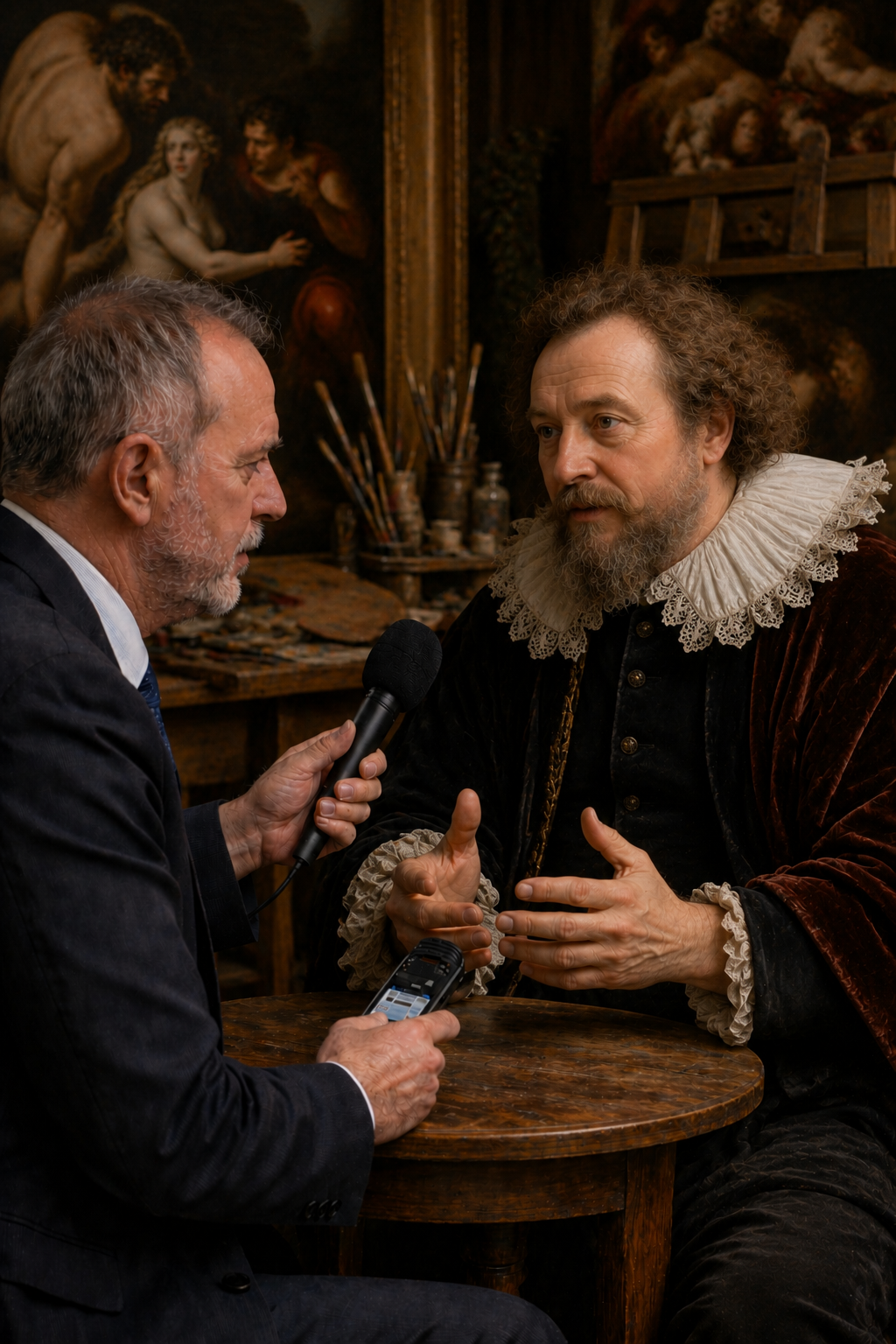
An ongoing series at stclaireart.com in which we imagine sitting down with the greatest artists in history.
First, I must say that Mr. Rubens arrived as if he owns the room — which, in a sense, he always did. Tall, well-dressed, at ease in a way that suggests a man who has dined with kings and enjoyed it. He looked around with genuine curiosity, took in the surroundings, and sat down without being invited. He was already smiling.
Me: You seem remarkably comfortable here for a man who has never seen the twenty-first century.
Rubens: I have been an ambassador. I have negotiated peace treaties between Spain and England. I have sat across tables from Philip IV and Charles I. (He gestures pleasantly at the room.) This is not so different. People are people. You want something from me, I want something from you. We will have a conversation and see where it goes.
Me: What do you want from me?
Rubens: (Leaning back, amused.) To be understood correctly for once.
Me: You were the most successful painter in Europe during your lifetime — wealthy, celebrated, knighted by two kings, running a studio with dozens of assistants. Did that ever feel like too much?
Rubens: Too much success? (He laughs warmly.) No. I will not pretend otherwise. I loved my work, I loved my life, I loved my home in Antwerp and my second home in the countryside. I loved my first wife and I loved my second wife. I loved the mornings in the studio when the light came in right and everything was going well. People seem to find this suspicious — as if a painter must suffer to be legitimate. I disagree entirely. Joy is not a lesser state than misery. It is harder to paint well, I think.
Me: Harder to paint joy than suffering?
Rubens: Much harder. Anyone can make you feel the weight of grief. To make you feel abundance, vitality, the sheer physical pleasure of being alive — that requires a different kind of skill. And more courage, frankly.
Me: Your figures are famous for their size, their flesh, their overwhelming physical presence. You painted bodies as celebrations. Was that a deliberate philosophy?
Rubens: It was a response to what I saw. The human body is extraordinary — its weight, its warmth, its capacity for movement and expression. I was not going to apologize for that or minimize it. When I painted a woman I painted a woman who existed fully in the world — who had weight and warmth and presence. The fashion now, I understand, is for something rather different.
Me: Rather different, yes.
Rubens: (Drily.) The world has always had opinions about how women should look. I ignored them then. I imagine I would ignore them now.
Me: What do critics and historians get most wrong about you?
Rubens: That I was merely prolific. As if the quantity of work somehow dilutes the quality. Yes, I ran a large studio. Yes, I had assistants who worked on backgrounds and drapery. This was normal — this was how it was done. But the hand that mattered was always mine, and anyone who looks carefully at the work knows exactly where I am in it and where I am not. Prolific is not the same as careless. I was never careless.
Me: Fair point. You also spoke six languages, served as a diplomat, and maintained one of the great libraries in Europe. Did painting ever feel like just one thing among many?
Rubens: Painting was always the center. Everything else orbited it. The diplomacy I did because it needed doing and I happened to be useful. The languages I learned because I was curious. The library because I could not stop reading. But every morning I went back to the studio. That was always where I lived most fully.
Me: If you had one day here — in this world, in 2026 — what would you do first?
Rubens: I want to see the museums. Not just my own work — I want to see everything that came after me. What did the French do in the nineteenth century? What happened after that? I have been told that painting went in directions. That would be surprising to see, I think.
Me: That might be an understatement.
Rubens: (With genuine delight.) Even better. I was never interested in the expected.
Me: Lastly, what would you say art is actually for?
Rubens: For celebrating existence. I know that is not a fashionable answer — suffering and struggle make better stories, I understand. But I painted life as I found it — abundant, complicated, sometimes violent, sometimes tender, always overwhelmingly present. Art at its best says: look at this. Look at how extraordinary it is to be here, in a body, in a world full of color and light and other people. That is not a small thing. That is, in fact, everything.
Peter Paul Rubens (1577–1640) was a Flemish Baroque painter, diplomat, and humanist scholar widely regarded as the greatest Northern European painter of his age. Fluent in six languages and knighted by both Philip IV of Spain and Charles I of England, he ran the most sought-after studio in Europe while simultaneously conducting diplomatic missions across the continent. His best known works include The Descent from the Cross, the Marie de' Medici cycle, and The Garden of Love.
This is an imagined interview. Rubens' responses are constructed from historical research, his surviving letters, contemporary accounts of his personality, and close study of his life and work. No direct quotes are presented as real.
No deceased artists were harmed in the making of this series.